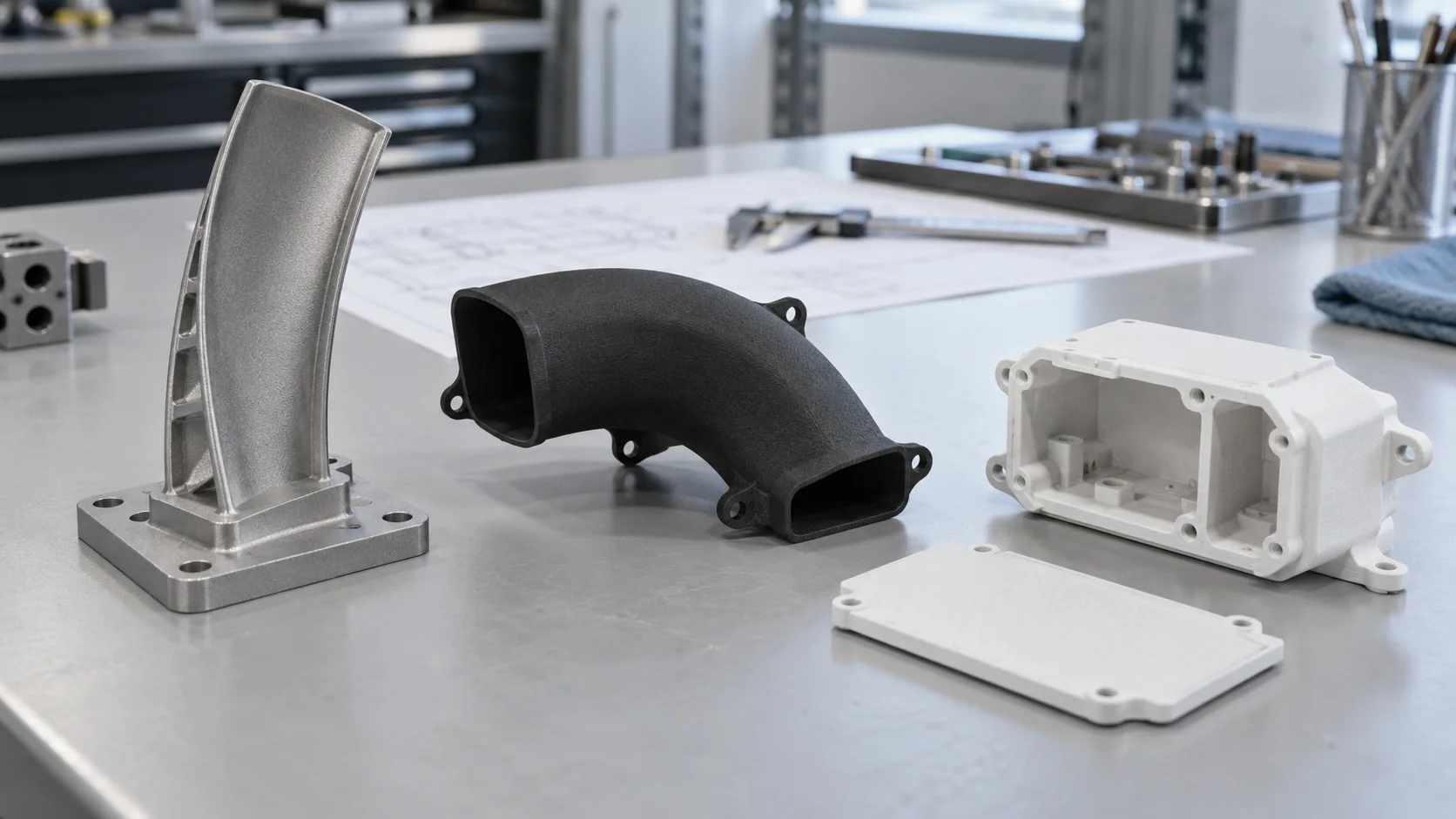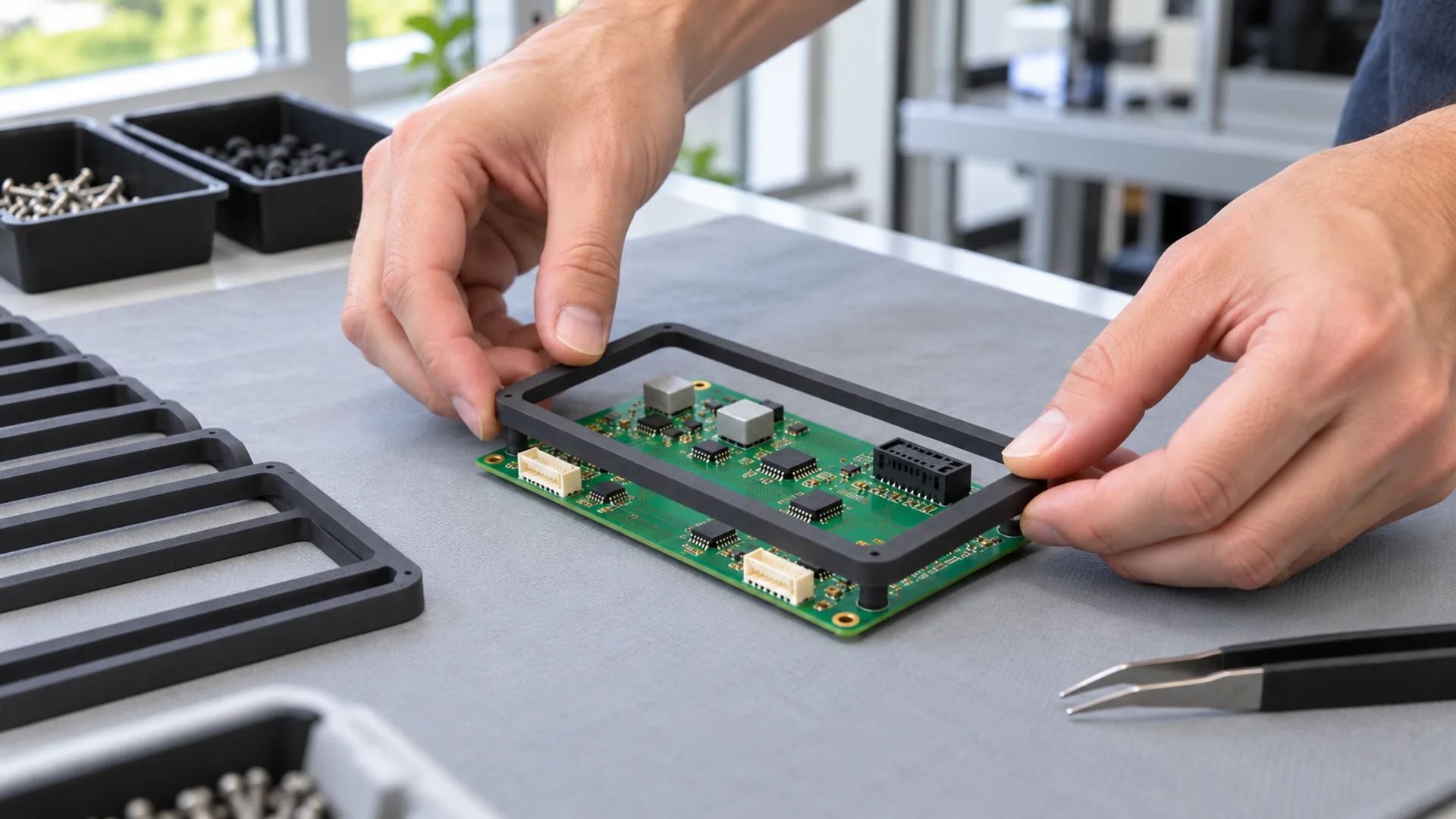
This small black nylon frame is reordered from one unchanged file, in batches sized to demand. SLS makes that practical without a mould: the stored file defines the part, shared builds handle small quantities, and the same material and dye process keep repeat shipments consistent.
The part is a small frame that locates an electronic module inside the customer's equipment. It is smaller than a business card, only a few millimetres tall and weighs under two grams. It is made by Selective Laser Sintering (SLS) in black Nylon PA12. Repeat orders were built from the same file with no design change. Every order that carried a promised date shipped early.
The Project at a Glance
- Application: end-use production component, reordered in small batches to demand
- Part: a small black locating frame for an electronic module
- Process: SLS, 100 µm layers
- Material and finish: Nylon PA12, depowdered, bead blasted and dyed black in-house on DyeMansion equipment, with no inserts, threads, smoothing or paint
- Orders: repeat batches from one unchanged file, with zero design revisions
- Delivery: a median of 3 business days from order to shipment; every dated order shipped 1 to 10 days early
A Thin Frame With Small Features
The part is a thin open frame with small locating features and a raised identification mark. It is mostly thin wall, with very little solid material anywhere, which is the kind of geometry where a powder-bed process is at its most comfortable.
Black PA12 was already specified for this design. The manufacturing value comes from keeping that small, detailed part easy to order and consistent to assemble as demand changes.
Process ChoiceWhy Powder-Bed Nylon Fits This Part
No supports, no draft
In SLS, unsintered powder supports the part throughout the build. Small pins, open windows, thin lips and raised text all print without support structures and without draft angles. There is nothing to remove afterward that could leave a witness mark on a cosmetic edge. In an injection mould, text on a face parallel to the draw direction would likely need a side action. In SLS the same text costs nothing extra.
What the tooling route would have asked for
Orders arrive in small batches, at irregular intervals, as the customer needs them. Consider what a moulded version of this part would require before the first good part: a tool designed and cut, probably with a side action for the identification mark, then sampled and approved. Between runs the tool has to be stored and maintained, and each run has to be large enough to justify its setup. A design change means modifying or replacing the tool, and any stock of the old revision becomes a write-off risk.
The printed route asks for none of that. The first order shipped three business days after it was placed, from a file. Each batch is sized to the need, and the only fixed asset is the file itself. A mould can still win at high enough volume, and that is a calculation worth doing for any part. At these batch sizes, the printed part carries no tooling commitment at all.
Tough nylon for a thin locating frame
PA12 gives a thin frame the toughness to handle being picked up, positioned and fitted around an electronic module. Its ability to flex under load is useful around slender locating features, where a small amount of movement helps during assembly. The open frame keeps material and weight low while putting support where the module needs it.
Build orientation helps those small features resist bending in the directions they will be handled and loaded. After printing, depowdering and bead blasting prepare an even surface for the black dye, which colours the nylon below the surface and preserves the fine locating detail. That short finishing route is straightforward to repeat as more parts are needed.
A revision is a file change
The same design has been used for every order. If it changes, that means a new file and a new revision letter in the raised mark. No tool needs to be modified or scrapped, and no stock of the old revision is tied up in a minimum run.
ProductionHow Each Reorder Runs
A full batch of this part is far too small to justify a dedicated build. It takes only a small slice of a build's capacity, so it is nested alongside other orders in an overnight run on our EOS P110 Velocis machines. The available build records show printing starting the same evening the order was released or the following day, with each full batch in one build.
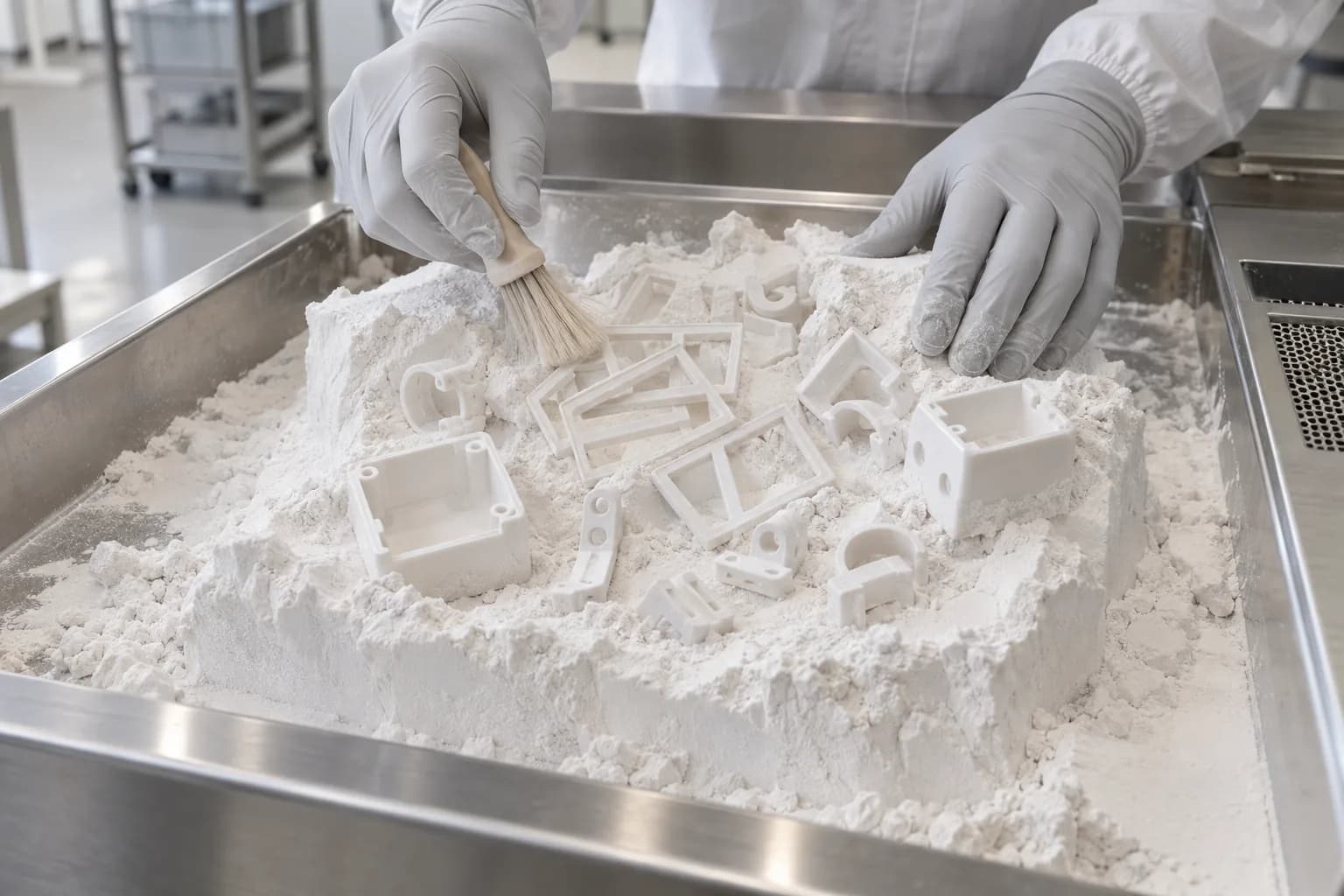
Small batches ride in builds that are already scheduled, so they do not wait for a dedicated run.
That changes where lead time comes from. On the logged orders, waiting for a machine was not the constraint. The slowest order took seven business days because it spent longer in the finishing queue, and it still shipped ahead of its promised date. For a part like this, depowdering, blasting, dyeing, counting and packing set the pace, not printing.
| Measure | Recorded result | Planning lesson |
|---|---|---|
| Order to shipment | 3 to 7 business days | Include finishing, counting and packing in the schedule |
| Orders with a promised date | All shipped early | Agree the need date when ordering |
| Logged builds | Started the same evening or next day | Small batches can join shared builds |
Later orders were smaller and more frequent. Without a minimum order quantity, the customer can order closer to demand, which allows it to hold less stock. No tooling or setup charge pushes it toward bigger, less frequent orders.
Process RecordsWhat Stays the Same Between Batches
On a repeat part, consistency starts with holding inputs constant. The same print file was used for every order, along with the same material, 100 µm layer height and black dye finish. A consistent machine model and finishing sequence give each batch the same manufacturing starting point.
For each build, Forge records the machine, the supplier's powder lot, the process temperatures and the X/Y shrink-scaling calibration. SLS parts shrink as they cool, and the scaling, typically around 3% on PA12, compensates for it. These records make a later question answerable: which machine, which powder and which settings produced the parts in a given shipment.
Inspection connects that process consistency to the fit that matters in assembly. Checking the locating features on finished parts helps establish the clearances needed around the module and gives future batches a useful dimensional reference.
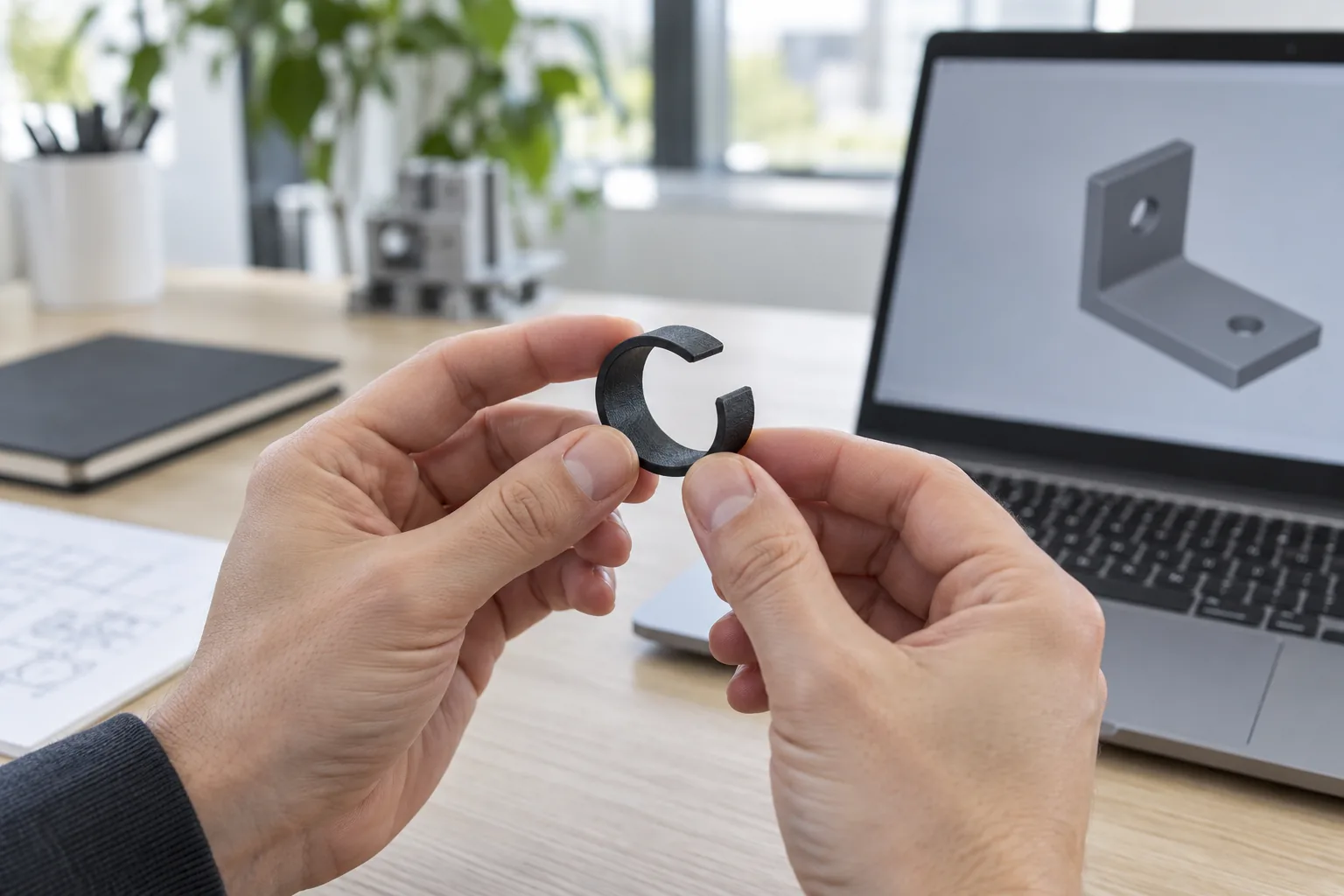
On a repeat printed part, the controlled file plays the role a production tool plays in moulding.
A Black Finish That Preserves Fine Detail
SLS PA12 prints off-white. We add the black finish in-house using DyeMansion equipment after depowdering and bead blasting. Preparing the surface evenly helps the dye produce a consistent shade and gives the frame a uniform feel during handling.
Colour around small locating features
Dye penetrates around 0.2 mm into EOS PA 2200 nylon, with depth varying by material and surface finish. That keeps the colour within the surface while preserving the edges of raised identification marks and small locating features. On a frame this thin, adding colour without a paint layer helps retain the detail that positions the module.
Fit and wear at the contact surfaces
Smooth lead-ins and clearance around the module help it seat without scraping across the frame's small features. Deep abrasion can expose the lighter nylon below the dyed surface, so the contact geometry matters wherever parts slide against each other. Checking critical dimensions after the heated dyeing process captures the fit of the finished part that will reach assembly.
Why it helps on a reorder
Matching the dye recipe to the nylon and using the same surface preparation helps repeat batches look consistent alongside existing stock. An approved colour sample gives a practical reference for future orders. For visible trim and housings, colour retention also matters: standard DyeMansion black resists fading under light and heat better than the conventional textile dye tested alongside it, helping exposed parts keep a consistent appearance in use.
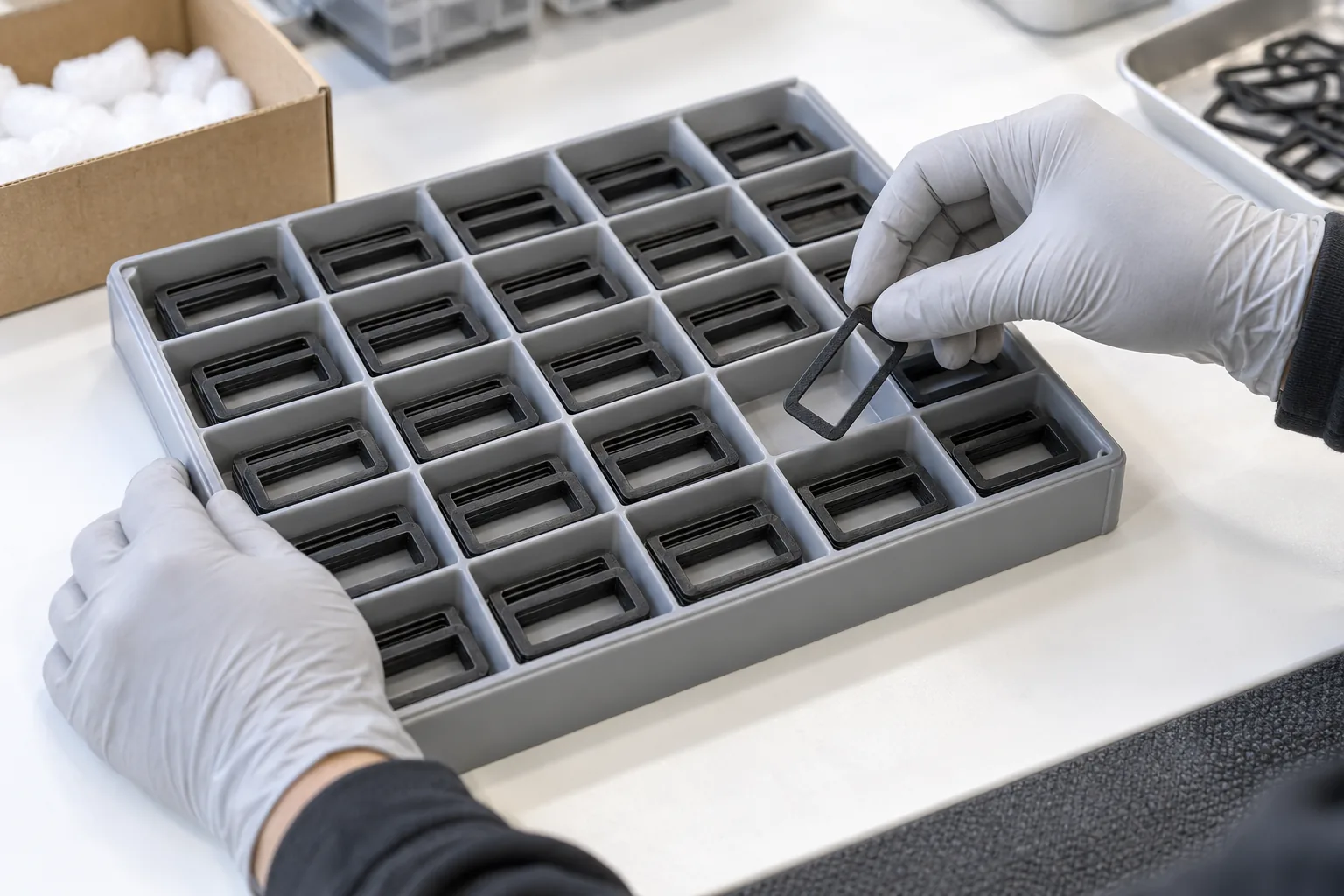
Dyed from a matched recipe after the same blasting step, one batch of black parts should match the next.
The finish is part of the design wherever appearance and fit meet. Recording the agreed colour and finishing method alongside the part specification keeps both requirements clear on repeat orders. Our 3D printing surface finishes guide explains the options for each process.
LessonsWhat to Apply to Your Own Repeat Parts
- Treat the print file like tooling. One unchanged file produced every batch, so every batch was built from identical geometry. Keep that file as a controlled master, such as a locked revision in your PLM system or a saved part record with your supplier, and reorder from it rather than from whatever copy went out last time. Change it only through a revision.
- Put the revision on the part. A raised part ID and revision letter on a non-cosmetic face makes printed stock self-identifying, so old and new revisions are easy to tell apart on the shelf. On a printed part, a new revision is a file swap and a new letter.
- Write drawings for the process. Declare the 3D model as master, with drawing dimensions as reference. Use a proportional tolerance with a floor rather than machining-style limits on every feature. Our published tolerance for SLS PA12 is ±0.3% with a ±0.3 mm minimum, and on a small part the minimum governs. Call out only the features that truly need tighter control.
- Keep small features above the process floor. Our SLS design guide sets a 0.8 mm minimum supported wall (0.8 to 1.0 mm recommended), 1.5 mm for unsupported walls, a 0.8 mm minimum pin diameter, and raised or recessed detail at least 0.5 mm wide and 0.5 mm deep. Stating minimum wall and feature sizes on the drawing makes the spec easy for a capable SLS supplier to meet.
- Size batches to fit a shared build. A batch that takes a small slice of a build can join the next scheduled one. Lead time is then set by finishing and handling, not by waiting for machine time.
- Order to demand, not to a minimum. With no tooling or minimum order quantity, you can order smaller batches more often as demand changes.
- Lock colour and finish into the reorder. Put the colour, how it is achieved (dyed, painted or coated) and the surface finish on the drawing and the PO, and reorder from a saved configuration, so nothing defaults back to a standard option between batches. For dyed parts, ask your supplier how the recipe and pre-dye blasting are held constant from lot to lot, and keep a first-lot part as the shade reference.
- Agree a simple lot check. A full first-article inspection on the first lot, then a quick go/no-go fit or a caliper check on one or two critical features per lot, is usually enough for a stable printed part. Agree it up front so every lot is judged the same way.
- Ask for build records. For each lot, a supplier should be able to tell you the machine, the powder lot, the process temperatures and the scaling used. On a repeat part, that record is what lets you trace any question back to a specific build.
Could One of Your Parts Run the Same Way?
The best candidates look like this one. They are small and thin-walled, with detail that would complicate a mould, and are ordered in tens or low hundreds at irregular intervals. Their design should be stable, but changes should stay cheap. Trim frames, cable guides, clips, small electronics housings and locating features all fit that pattern on vehicle equipment.
For parts near fluid lines or lubricated equipment, chemical resistance helps preserve the locating features and mounting points that keep an assembly together. EOS PA 2200 is resistant to petrol, brake fluid and antifreeze in four-week testing at 60 °C. MJF PA12 also resists attack from the tested automotive oils, grease, brake fluid and coolant. Coolant can soften it slightly, making the resulting change in stiffness relevant to clips or features that hold position under load.
Sun-exposed parts benefit from a UV-resistant material such as ASA, or a protective coating on PA12, to help retain strength through outdoor exposure. For vehicle interiors with an FMVSS 302 requirement, HP HR PA12 on the Jet Fusion 5200 has passed the interior-material flammability test, providing a documented material option when planning the part's qualification.
For design rules by process, see our 3D printing design guidelines. For more vehicle applications, see 3D printing for automotive and our end-use part manufacturing service.
Have a Part You Reorder Regularly?
Send us the file, drawing and typical batch size. We will recommend a process and material and set the part up for repeat orders. Lead times start at 2 business days, 24-hour turnaround is available on request, and we offer next day shipping anywhere in the US and Canada.
Discuss your part with us