
Mechanical properties determine whether a 3D printed part will perform reliably in service. Engineers rely on metrics like tensile strength, modulus, and elongation to evaluate whether a material can withstand real-world loads — but additive manufacturing introduces variables that make those numbers more nuanced than a datasheet suggests.
This guide explains how to interpret mechanical property data for 3D printed materials, what process-specific effects change the numbers, and how engineers can apply that data when selecting materials and designing functional parts. Use our 3D printing material guide to compare available materials, or explore functional rapid prototyping to test your design before production.
Additive ContextWhy Mechanical Properties Behave Differently in 3D Printing
Unlike injection molding or CNC machining, 3D printed parts are built layer by layer. This manufacturing approach introduces variables that directly influence mechanical performance:
- Layer adhesion strength — bonding between successive layers is often weaker than bulk material strength.
- Build orientation — the direction a part is printed in changes which axis carries the load across layer boundaries.
- Internal structure — infill percentage, wall thickness, and lattice geometries create non-uniform density.
- Powder refresh ratios — in powder-bed systems like SLS and MJF, recycled powder affects crystallinity and mechanical performance.
- Post-processing — heat treatment, vapor smoothing, and surface finishing all shift the strength-ductility balance.
Because of these variables, the mechanical properties of printed parts can differ significantly from both raw material datasheets and traditionally manufactured equivalents. Engineers must evaluate properties using process-specific data rather than assuming bulk material performance.
Quick ReferenceTypical Mechanical Properties by Technology
The table below provides representative property ranges for common additive technologies and materials. These values give engineers a starting point for material screening before detailed analysis.
| Technology | Material | Tensile Strength | Modulus | Elongation |
|---|---|---|---|---|
| SLS | Nylon PA12 | ~45–50 MPa | ~1700 MPa | 15–20% |
| MJF | Nylon PA12 | ~48 MPa | ~1800 MPa | 18–20% |
| FDM | ABS | ~30–40 MPa | ~2000 MPa | 5–10% |
| FDM | PLA | ~50–60 MPa | ~3500 MPa | 3–6% |
| SLA | Tough Resin | ~55 MPa | ~2200 MPa | 10–20% |
| DMLS | AlSi10Mg | ~400 MPa | ~70 GPa | 5–8% |
| DMLS | 316L Stainless | ~550 MPa | ~190 GPa | 30–40% |
Values vary based on build orientation, machine calibration, and post-processing. Always validate against production-representative test data for critical applications.
Core MetricsKey Mechanical Properties Explained
Tensile Strength
The maximum stress a material can sustain before failure. In additive manufacturing, this value depends heavily on build orientation — a part loaded across layer boundaries will often fail at lower stress than the same geometry loaded in-plane.
Yield Strength
The stress at which permanent deformation begins. Design loads for dimensional-critical applications should remain below yield with an adequate safety factor. For 3D printed parts, yield data should come from specimens built in the same orientation as the production part.
Young's Modulus (Elastic Stiffness)
Describes how much a part deflects under load within the elastic region. A higher modulus means less deflection. Engineers use modulus to estimate whether a bracket, housing, or structural element will maintain dimensional stability under operating loads.
Elongation at Break
Measures ductility — how much a material stretches before fracture. This property is critical for snap fits, living hinges, and any geometry that must flex without breaking. SLS nylon typically offers 15–20% elongation, while FDM PLA may only reach 3–6%.
Toughness
The total energy a material absorbs before fracture, represented by the area under the stress-strain curve. Toughness combines both strength and ductility into a single metric. It is the primary consideration for impact-loaded and vibration-exposed components.
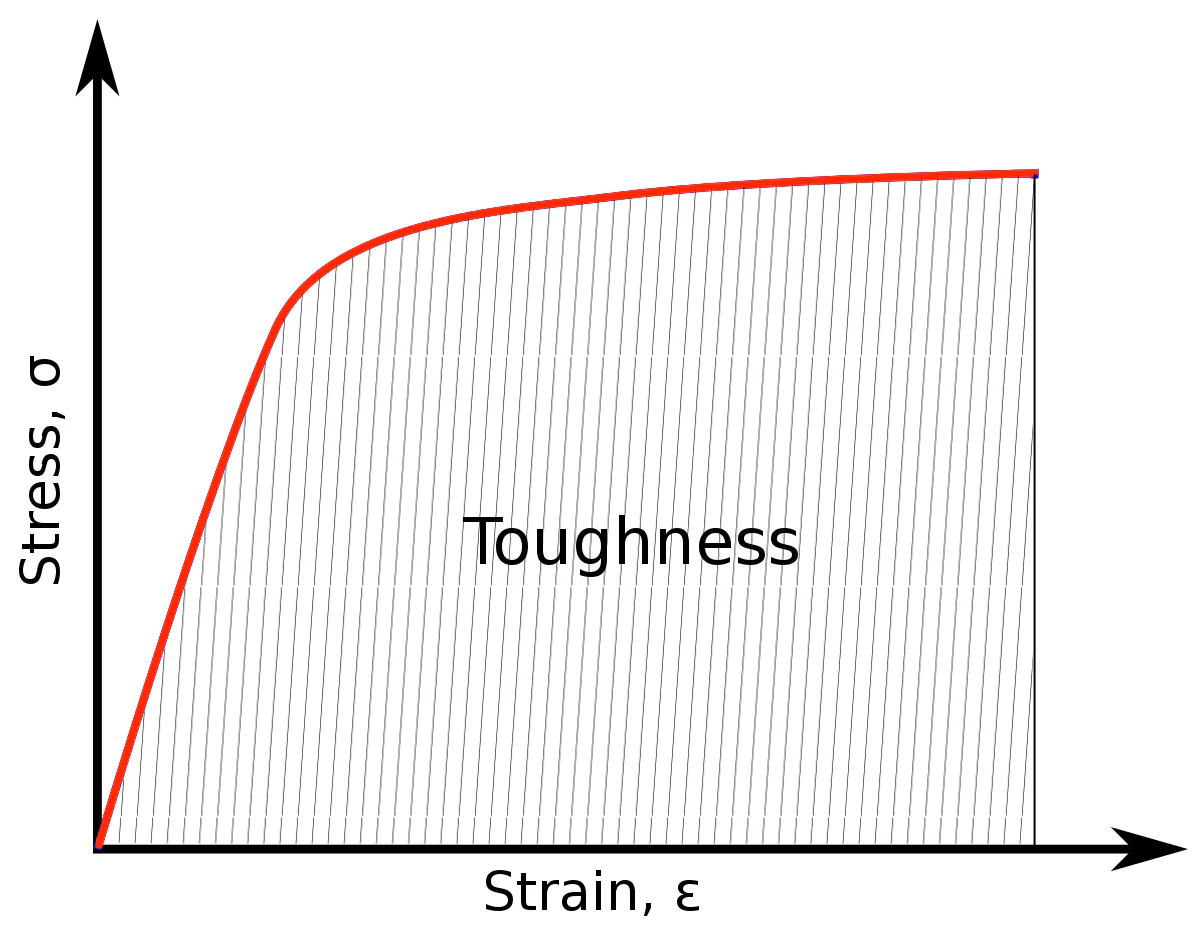
Toughness integrates deformation and strength behavior into a single performance indicator.
Reading Stress-Strain Curves
Tensile testing generates stress-strain curves that map material behavior from elastic loading through fracture. Each region of the curve corresponds to a design boundary.
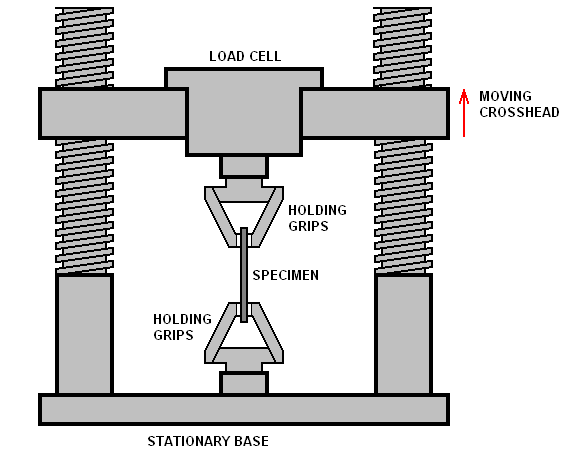
Standardized tensile testing is the foundation for repeatable mechanical characterization.
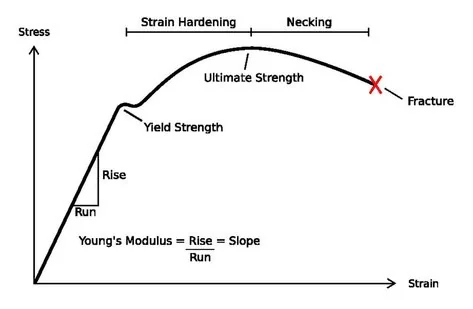
Each section of the curve corresponds to a different deformation mechanism and design limit.
Elastic Region
Deformation is fully reversible. The slope equals Young's modulus. Parts operating in this region will return to their original shape when unloaded. This defines the safe operating envelope for most structural components.
Yield Point and Plastic Region
Beyond yield, deformation becomes permanent. Crossing this threshold causes dimensional changes that cannot be recovered. For precision parts, design loads must stay below yield with a safety factor — typically 1.5–2.0x for additive components, depending on data confidence.
Ultimate Tensile Strength and Necking
Ultimate tensile strength (UTS) marks the maximum engineering stress. Ductile materials then enter necking — localized section reduction that precedes fracture.
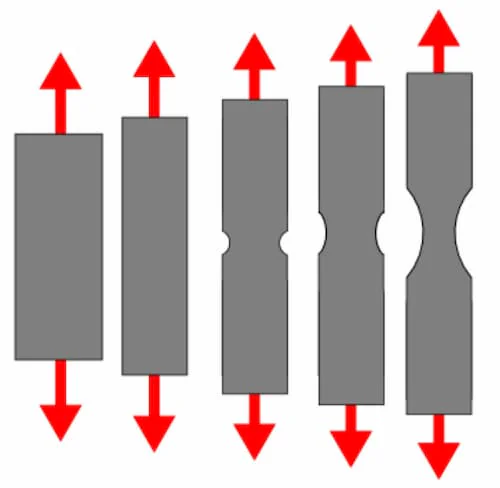
Necking reveals localized plastic instability ahead of final fracture.
Testing Conditions That Matter
- Specimen geometry and preparation to ASTM/ISO standards.
- Controlled strain rate and environment (temperature, humidity).
- Sufficient sample count for statistical confidence.
- Build orientation matching the intended production orientation.
How Additive Manufacturing Changes Mechanical Properties
Build Orientation and Anisotropy
Layer-by-layer manufacturing creates directional mechanical behavior known as anisotropy. In many additive processes, mechanical performance differs depending on load direction relative to the build layers. This is one of the most important factors engineers must account for when designing 3D printed parts.
| Load Direction | Relative Strength | Explanation |
|---|---|---|
| XY plane (in-plane) | Highest | Load carried within continuous material paths. |
| Z axis (across layers) | Lower | Load transfers across layer bonds, which are typically weaker. |
The degree of anisotropy varies by technology:
- FDM — Z-axis tensile strength can be 30–50% lower than XY. Inter-layer bonding depends on nozzle temperature, layer height, and chamber conditions.
- SLS / MJF — Closer to isotropic behavior due to powder-bed fusion, but still orientation-sensitive. Z-axis elongation is typically lower than XY.
- DMLS — As-built parts can exhibit significant anisotropy. Heat treatment and HIP (hot isostatic pressing) reduce directional differences but rarely eliminate them completely.
- SLA — Generally more isotropic than extrusion processes, but layer interfaces can still act as weak points under cyclic loading.
Design implication: Critical load paths should align with the strongest material orientation whenever possible. When loads are multi-directional, choose a technology with lower anisotropy (SLS/MJF for polymers, heat-treated DMLS for metals) or apply higher safety factors for cross-layer loading. See our part orientation guide for detailed strategies.
Layer Adhesion
Layer adhesion quality is the fundamental limiter of Z-axis performance. Weak bonding between layers creates the primary failure mode in many printed parts.
- In FDM, adhesion depends on nozzle temperature, ambient chamber temperature, and print speed. Heated chambers and optimized temperature profiles significantly improve inter-layer bond strength.
- In powder-bed fusion (SLS, MJF), sintering produces more uniform bonding across all directions compared to extrusion, resulting in better isotropy and more consistent mechanical performance.
- In DMLS, melt pool overlap and energy density control how well adjacent layers fuse. Insufficient energy creates porosity at layer boundaries that reduces both static and fatigue strength.
Internal Structure and Density
Parts are not always printed solid. Internal structure — particularly in FDM — significantly affects mechanical performance.
- Infill percentage: A 20% infill FDM part may have only a fraction of the strength of a fully dense part. Common production infill ranges from 50–100% depending on the application. See our infill techniques guide for optimization strategies.
- Wall thickness: Perimeter walls carry a disproportionate share of load. Increasing wall count often improves strength more efficiently than increasing infill density.
- Lattice structures: Advanced lattice designs can optimize the strength-to-weight ratio beyond what uniform infill achieves, but require validated simulation data.
Powder-bed technologies (SLS, MJF, DMLS) produce solid parts by default, which is one reason their mechanical properties are generally more consistent and predictable than FDM.
Post-ProcessingPost-Processing Effects on Mechanical Performance
Post-processing can significantly alter the mechanical properties of 3D printed parts — sometimes improving one property at the expense of another. Understanding these trade-offs is critical for engineering applications.
Polymer Post-Processing
| Process | Mechanical Effect | Typical Use |
|---|---|---|
| Vapor smoothing | Reduces surface roughness, improving fatigue resistance by eliminating micro-notches that act as crack initiation sites. | SLS/MJF parts in cyclic loading applications. |
| Annealing | Increases crystallinity, which can improve stiffness and heat resistance but may reduce ductility. | FDM and MJF parts needing higher heat deflection temperature. |
| Dyeing | Minimal mechanical impact when done correctly. Surface absorption only. | Cosmetic finishing for SLS/MJF nylon. |
Metal Post-Processing
| Process | Mechanical Effect | Typical Use |
|---|---|---|
| Stress relief | Reduces residual stresses from the build process, preventing warpage and improving dimensional stability. Minimal effect on bulk properties. | Required for nearly all DMLS parts before removal from build plate. |
| HIP (hot isostatic pressing) | Closes internal porosity and homogenizes microstructure. Significantly improves fatigue life and reduces anisotropy. | Aerospace and medical components requiring maximum reliability. |
| CNC machining | Achieves tight tolerances and smooth surfaces on critical interfaces. Removes surface defects that reduce fatigue life. | Mating surfaces, bearing seats, and precision interfaces. |
| Shot peening | Introduces compressive residual stress at the surface, significantly improving fatigue resistance. | Fatigue-critical metal components in aerospace and automotive. |
Fatigue and Long-Term Performance
Many engineering components experience cyclic loading rather than a single static load. A part that easily survives a one-time load may fail after thousands or millions of repeated cycles at a much lower stress level. Fatigue is one of the most common failure mechanisms in service — and one of the most under-evaluated in additive manufacturing.
Factors That Influence Fatigue Life
- Surface finish: Rough surfaces in additive parts act as stress concentrators and crack initiation sites. Smoother surfaces extend fatigue life. This is why vapor smoothing, machining, and shot peening can dramatically improve fatigue performance.
- Internal porosity: Voids within printed parts — particularly in metals — create internal stress risers that reduce fatigue resistance. HIP processing addresses this by closing internal pores.
- Residual stress: The rapid heating and cooling cycles in additive processes create residual stresses that can accelerate crack growth. Stress relief heat treatment mitigates this effect.
- Layer boundaries: In FDM parts especially, layer interfaces can serve as preferred crack propagation paths under cyclic loading.
Technology-Specific Fatigue Considerations
- Polymer systems (SLS, MJF, FDM): Fatigue data for printed polymers is less mature than for metals. SLS and MJF nylon generally offer reasonable fatigue performance for moderate-cycle applications. FDM parts are more variable due to infill and adhesion effects.
- Metal DMLS: As-built fatigue performance is typically 20–40% lower than wrought equivalents due to surface roughness and porosity. With optimized post-processing (HIP + machining + shot peening), fatigue properties can approach or match wrought material performance.
For fatigue-critical applications, prototype testing under representative cyclic conditions is essential. Datasheet values for static properties do not predict fatigue behavior.
Design RulesDesign Implications for Engineers
Understanding mechanical properties is only valuable when translated into design decisions. Here is how each core property maps to practical engineering choices:
- Use modulus to estimate deflection in load-bearing parts — brackets, housings, and structural frames.
- Use elongation at break when designing snap fits, living hinges, or any feature that must flex without fracturing.
- Use toughness for impact-loaded or vibration-exposed components where energy absorption matters.
- Use yield strength when designing structural parts that must maintain dimensional stability under sustained load.
- Use fatigue data when parts will experience repeated loading cycles — not static tensile values.
Example: Designing an SLS Nylon Bracket
Requirements:
- Applied load: 120 N static
- Maximum allowable deflection: <1 mm
- Operating temperature: 60°C continuous
Material selected: SLS Nylon PA12
Reasoning:
- Yield strength ~45 MPa provides adequate safety factor at the design load.
- Modulus ~1700 MPa allows deflection calculations to confirm the <1 mm requirement.
- Good fatigue resistance for moderate-cycle applications.
- HDT of ~175°C accommodates the 60°C operating environment.
Design choices driven by property data:
- Added ribs to increase section modulus and reduce deflection.
- Oriented the part so primary load direction aligns with XY plane (strongest orientation).
- Applied a 2.0x safety factor against yield to account for AM process variability.
A snap-fit enclosure printed in SLS nylon relies primarily on elongation and fatigue resistance, whereas a structural bracket is governed by modulus and yield strength. Different parts demand different property priorities — there is no single "best" material.
Material BehaviorHow Major 3D Printing Material Classes Differ
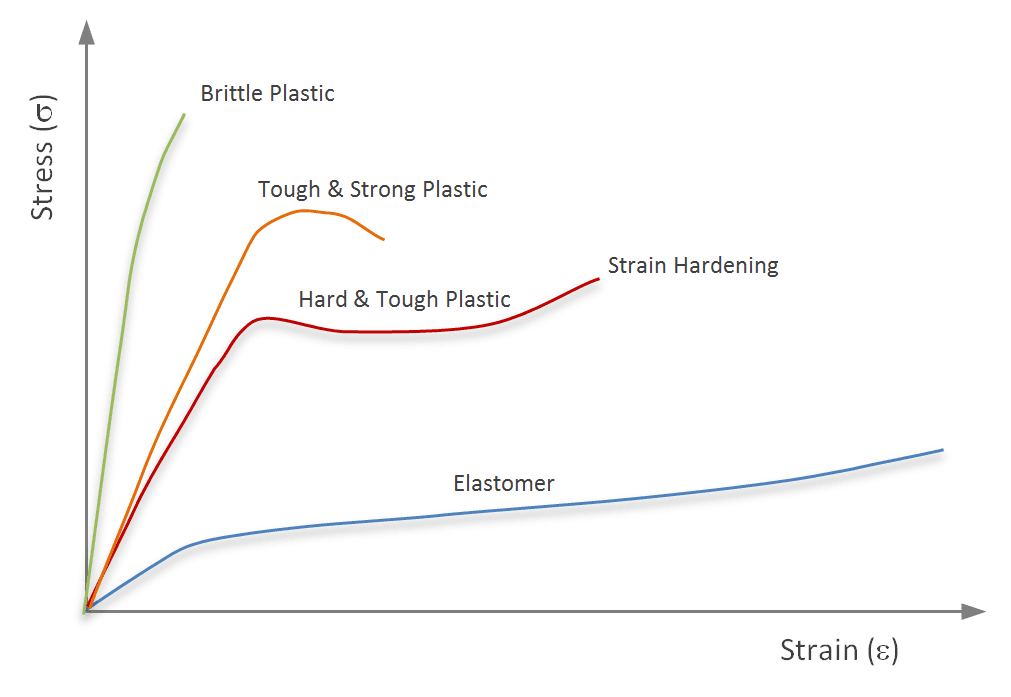
Different additive material families show distinct stress-strain profiles. Recognizing these patterns simplifies early-stage material screening.
| Material Class | Typical Mechanical Pattern | Common Use Fit |
|---|---|---|
| Thermoplastics (FDM/SLS/MJF) | Moderate-to-high ductility with useful plastic deformation. SLS/MJF offer more consistent properties than FDM. | Functional prototypes, tooling, jigs, fixtures, moderate-load production parts. |
| Photopolymers (SLA/PolyJet) | Higher stiffness, lower ductility, more brittle failure modes. Properties may degrade with UV exposure over time. | High-detail visual models, geometry validation, short-term functional testing. |
| Metals (DMLS) | Comparable to cast or wrought metals with process-dependent anisotropy. Post-processing significantly influences final properties. | High-performance structural, thermal, and load-bearing applications. |
| Elastomers (TPU/Rubber-like) | Very high elongation, low modulus, excellent energy absorption. Hardness measured in Shore A rather than tensile metrics. | Seals, gaskets, vibration damping, flexible connectors. |
Material Selection Workflow
- Define load conditions: Identify static loads, cyclic loads, impact events, and thermal environment.
- Determine allowable stress: Set safety factors based on consequence of failure and data confidence.
- Screen materials by property: Compare yield, modulus, elongation, and toughness against requirements.
- Account for process effects: Adjust for orientation, anisotropy, and post-processing before final selection.
- Validate through testing: Prototype-test under representative conditions and update design allowables.
Industry-Specific Mechanical Requirements
| Industry | Primary Mechanical Focus | Qualification Emphasis |
|---|---|---|
| Aerospace | Fatigue resistance, high-temperature stability, damage tolerance. | Strict standards (MMPDS/CMH-17), process traceability, batch-to-batch statistics. |
| Medical | Long-term stability, cyclic reliability, sterilization resistance. | Biocompatibility testing, validation of sterilization impact on properties. |
| Automotive | Impact resistance, thermal cycling, environmental durability. | Application-specific test protocols, cost-performance optimization. |
| Consumer Products | Impact safety, surface durability, drop resistance. | Regulatory compliance, accelerated aging, UL and CE requirements. |
Where to Get Reliable Mechanical Data
Mechanical property data for 3D printed materials comes from several sources, each with different levels of reliability:
- Machine manufacturer datasheets: Provide baseline values but are typically generated under ideal conditions with optimized settings. Useful for initial screening but not for final design.
- Material supplier documentation: Often includes more detailed property data across orientations and post-processing states.
- Internal process qualification testing: The most reliable source for production design. Properties measured from your actual machine, settings, and post-processing workflow.
- Independent testing laboratories: Third-party verification for regulatory compliance and critical applications.
Engineers should prioritize data generated under production-representative conditions. Printed properties depend heavily on machine settings, build orientation, and post-processing — generic supplier data is a starting point, not a design allowable.
Conclusion
Mechanical property analysis allows engineers to move beyond guesswork when designing 3D printed components. By understanding stress-strain behavior, accounting for anisotropy and process-specific effects, and validating with production-representative test data, teams can select the right material and design parts that perform reliably in real-world applications.
Further Reading
- 3D printing materials library
- Comparing 3D printing technologies
- Design guidelines for 3D printing
- Metal additive materials and selection criteria
- Advanced DMLS design optimization techniques
- Part orientation strategies for 3D printing
- SLS vs FDM comparison
- MJF vs SLS comparison
- FDM infill techniques and optimization
Need Help Selecting a Material?
If you're evaluating materials for a functional 3D printed component, our engineering team can help analyze load conditions, safety factors, environmental exposure, and manufacturing constraints. Upload your CAD file and we'll recommend the best material and technology for your application.
Talk to our engineering team