
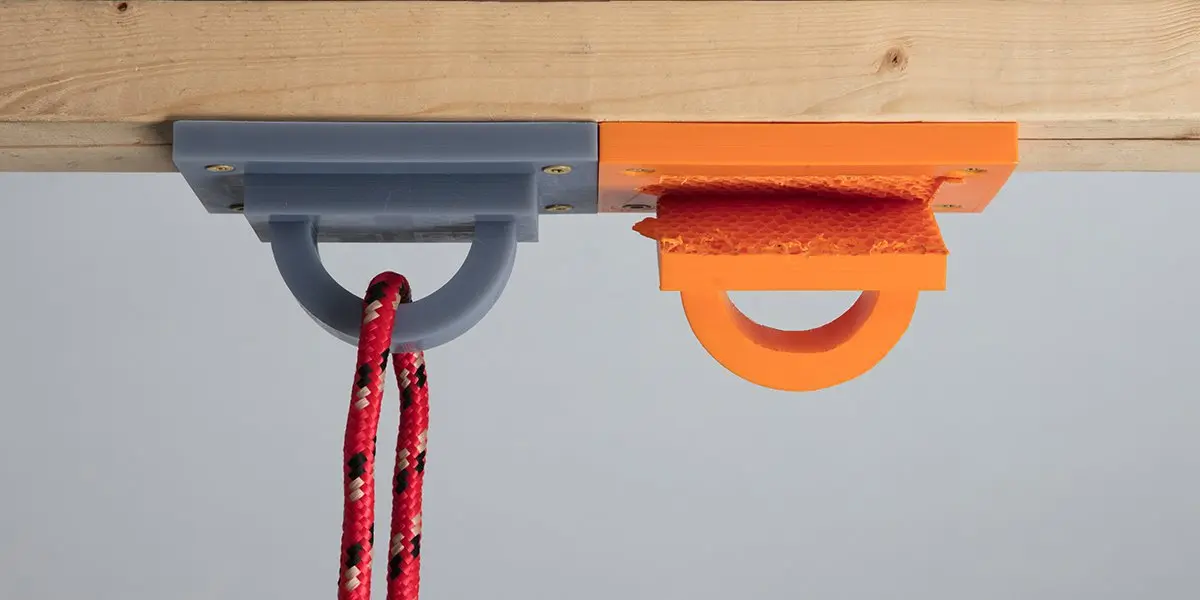
Infill strategy is one of the highest-leverage controls in FDM printing. With the right pattern and density, engineers can reduce material use significantly while preserving the mechanical behavior required for the part’s actual load case.
Too often, infill is chosen by habit rather than requirement. This guide frames infill as an engineering decision: match internal structure to function, optimize for strength-to-weight ratio, and avoid paying for unnecessary print time and material.
Key Takeaways
- Infill optimization can reduce material usage by 30-70% depending on part function.
- Pattern selection changes load response as much as density in many geometries.
- Infill percentage should be set from performance criteria, not default slicer values.
- Variable-density workflows can place strength only where the part actually needs it.
Understanding Infill in FDM Printing
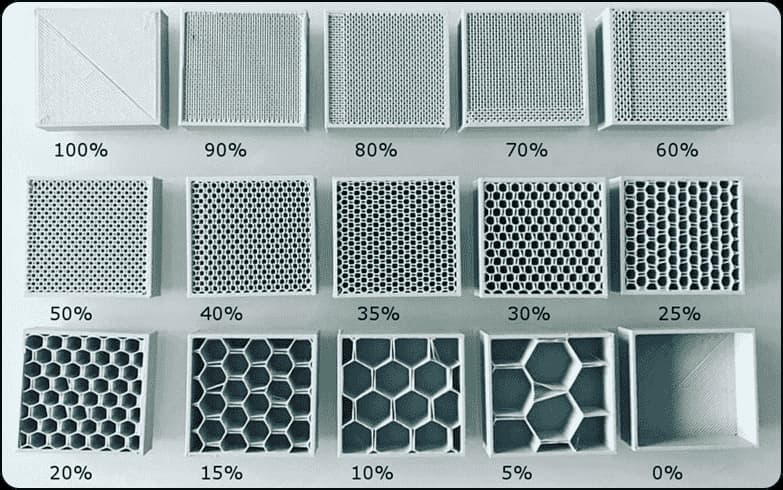
Infill density directly changes mass, print time, and internal load path behavior.
Infill is the internal lattice generated by the slicer between external perimeters. Because FDM builds layer by layer, this interior geometry can be controlled precisely. Instead of printing fully solid parts by default, teams can engineer the internal structure to meet stiffness and strength targets with lower mass and lower cost.
| Infill Setting | Internal Condition | Typical Use Case |
|---|---|---|
| 0% | Hollow core with perimeter walls only | Visual models and low-load forms |
| 20-40% | Structured internal support network | Functional prototypes and moderate loading |
| 60-100% | Dense or fully solid interior | High-load or safety-critical features |
The Engineering Significance of Infill
Infill selection affects both performance and economics. Structurally, it changes stiffness, compressive response, impact behavior, and local failure modes. Economically, it controls print time, filament consumption, machine utilization, and total part cost.
Why This Matters in Production
- Lower infill can cut cycle time and cost for non-critical geometries.
- Higher or targeted infill improves reliability in stress-concentrated regions.
- Well-tuned infill often delivers the best ROI before changing materials or hardware.
For weight-sensitive programs in aerospace and automotive, infill optimization is especially valuable because it can reduce part mass while retaining required mechanical performance.
Common Infill Patterns and Application Fit
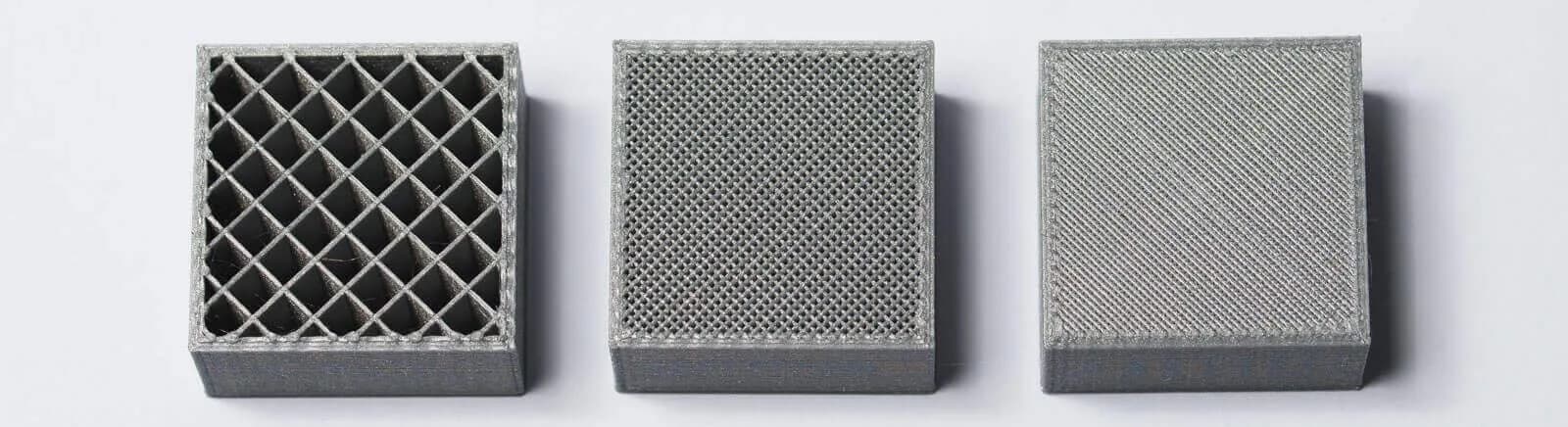
Pattern choice changes force distribution, rigidity, and print efficiency.
| Pattern | Primary Strength Behavior | Efficiency Notes | Typical Density Range |
|---|---|---|---|
| Rectilinear/Grid | Balanced and predictable for general loads | Fast to print and broadly compatible | 15-50% |
| Triangular | High rigidity and strong compression response | Slightly slower than grid, higher stiffness payoff | 20-40% |
| Honeycomb | Good strength-to-weight distribution | Material-efficient for large-volume parts | 10-35% |
| Gyroid | Near-isotropic behavior and strong energy absorption | Excellent performance at moderate mass | 15-40% |
No pattern is universally best. Pattern and density should be co-selected from the part’s load direction, failure risk, and manufacturing constraints.
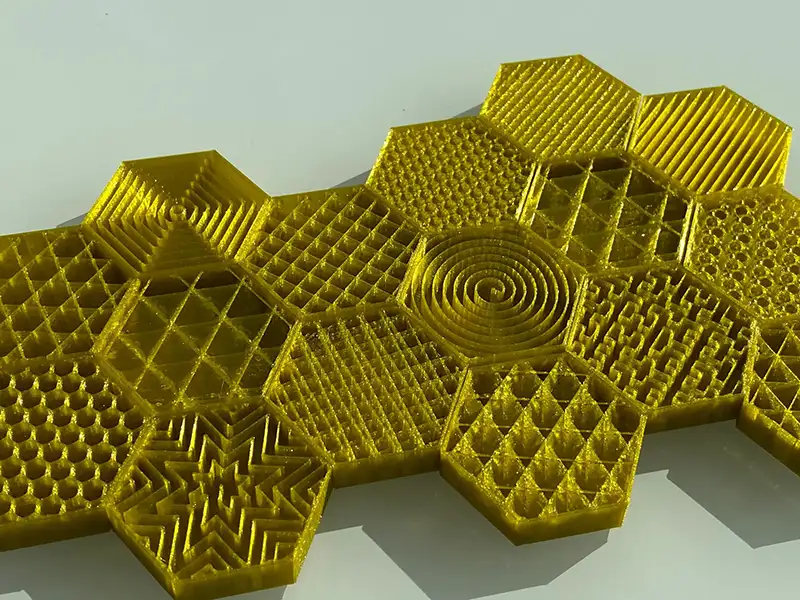
Gyroid structures provide strong strength-to-weight behavior with continuous internal geometry.
Balancing Strength and Material Efficiency
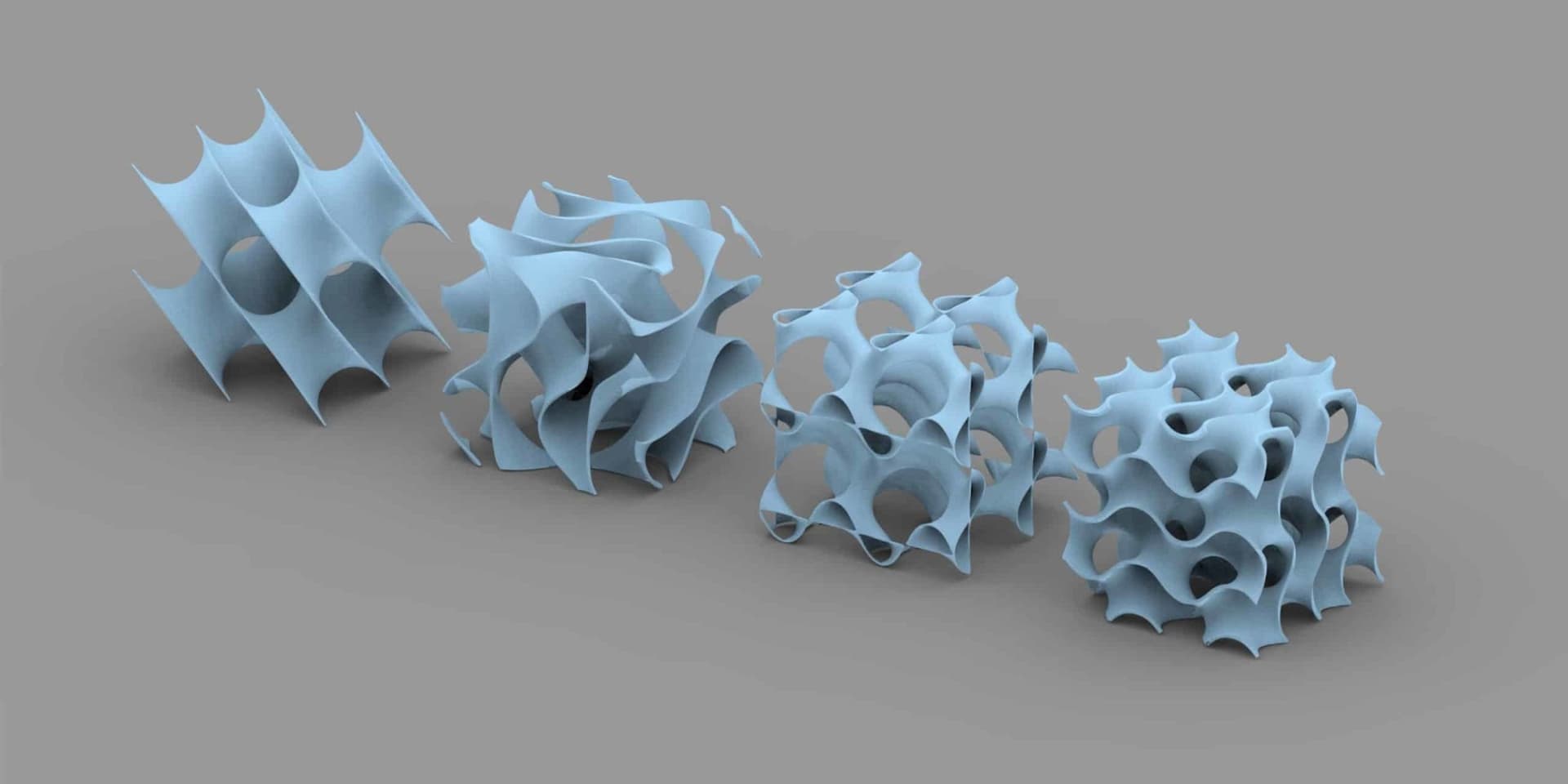
Mechanical performance does not scale linearly with infill percentage.
In many parts, moving from moderate infill to very high infill yields diminishing mechanical gains while sharply increasing time and material cost. That is why the target should be “minimum density that passes requirements,” not “maximum density for safety.”
| Part Intent | Typical Infill Range | Optimization Goal |
|---|---|---|
| Display / Aesthetic | 10-20% | Low mass and fast prints |
| Functional Prototype | 20-40% | Balanced validation of fit and mechanics |
| Production / High Load | 40-70% | Durability and load reliability |
Advanced Infill Optimization Strategies
Variable Infill Density
Variable density applies high infill only in stressed zones and lower infill elsewhere. This improves strength efficiency by aligning material placement to actual load paths.
- High-stress zones: typically 50-70%
- Moderate zones: typically 25-40%
- Low-stress volume: typically 10-20%
Layer Height and Nozzle Pairing
Infill behavior changes with deposition scale. Smaller layers and nozzles improve detail and local feature control, while larger extrusion settings improve throughput for large-format components.
Slicer-Level Controls
Modern slicers enable adaptive infill, modifier volumes, and gradual transitions that can materially improve performance without increasing full-part density.
Industry-Specific Use Cases
Application context determines strategy. What works for a visual architecture model is not appropriate for a load-bearing aerospace bracket.
Aerospace
Commonly prioritizes weight reduction with validated strength margins. Triangular or gyroid patterns at moderate densities are often used in brackets, fixtures, and non-flight-critical assemblies.
Automotive
Balances throughput and durability for fixtures, jigs, and validation parts. Density and pattern selection typically depend on expected stress cycles and thermal exposure.
Medical Device Manufacturing
Emphasizes repeatability, documentation, and fit performance. Infill is selected to support required stiffness and cleaning/handling behavior while controlling print economics.
Architectural Scale Models
Usually targets visual quality and cost control. Lower-density strategies are common except in thin or handling-sensitive sections.
Implementation Workflow
- Define functional requirements and loading conditions first.
- Select candidate patterns based on expected load behavior.
- Run density sweeps to identify the minimum passing configuration.
- Validate with print tests and dimensional/mechanical checks.
- Lock a repeatable slicer profile and document for production reuse.
Conclusion
Infill optimization is not a cosmetic slicer setting—it is a core engineering variable. Teams that tune infill by requirement rather than default values consistently achieve lighter parts, faster cycles, and lower manufacturing cost without sacrificing performance.
Further Reading
- Industrial FDM Technology Guide
- FDM Design Guidelines and Best Practices
- Complete 3D Printing Technology Comparison
- Aerospace Applications of Additive Manufacturing
Need Help Optimizing Infill for a Production Program?
Forge Labs can help define pattern, density, and process settings to meet your strength, weight, and cost targets.
Talk to engineering