Metal additive manufacturing gives engineering teams a different design space than casting or machining. With DMLS, geometry can be tuned for load path, thermal behavior, and mass efficiency in ways that are often not feasible with conventional production routes.
This guide covers practical, production-oriented design techniques for DMLS: orientation strategy, support planning, topology optimization, lattice integration, simulation workflows, and post-processing-aware design decisions.
What You Will Learn
- DMLS fundamentals that directly affect manufacturability.
- Critical design constraints and how to design around them.
- Advanced optimization approaches for weight and performance.
- How to integrate post-processing and machining into early design.
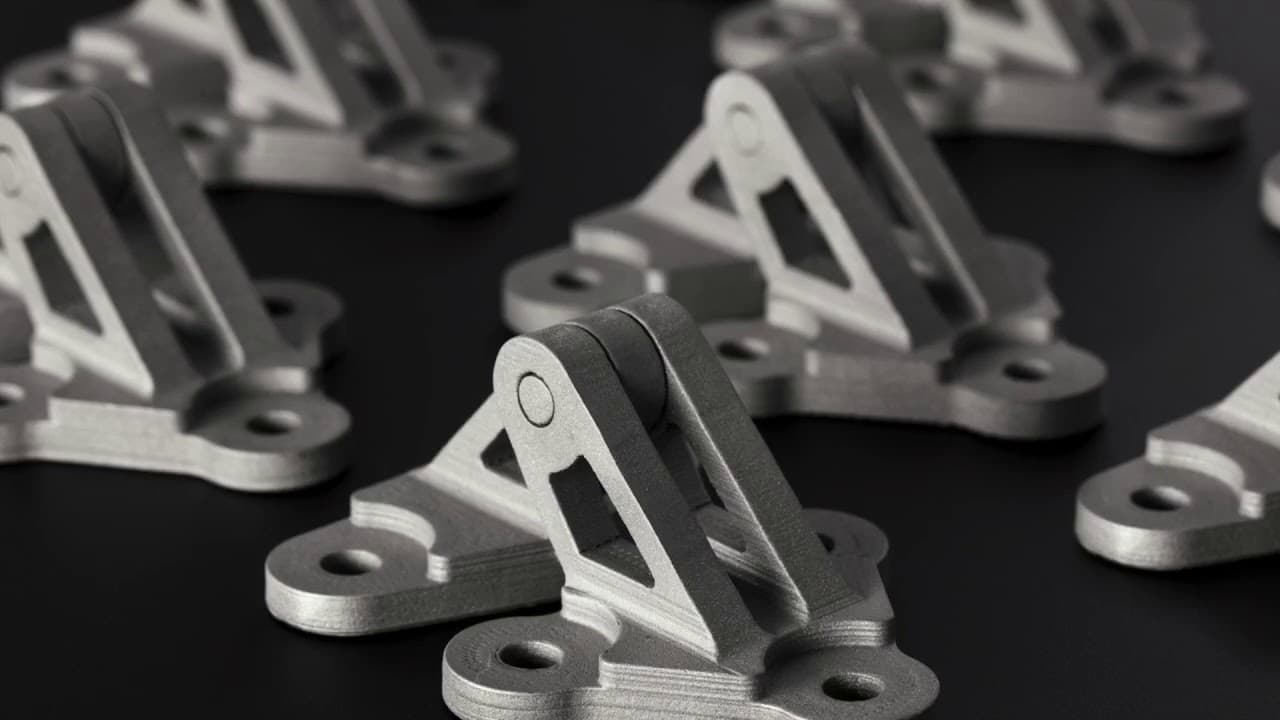
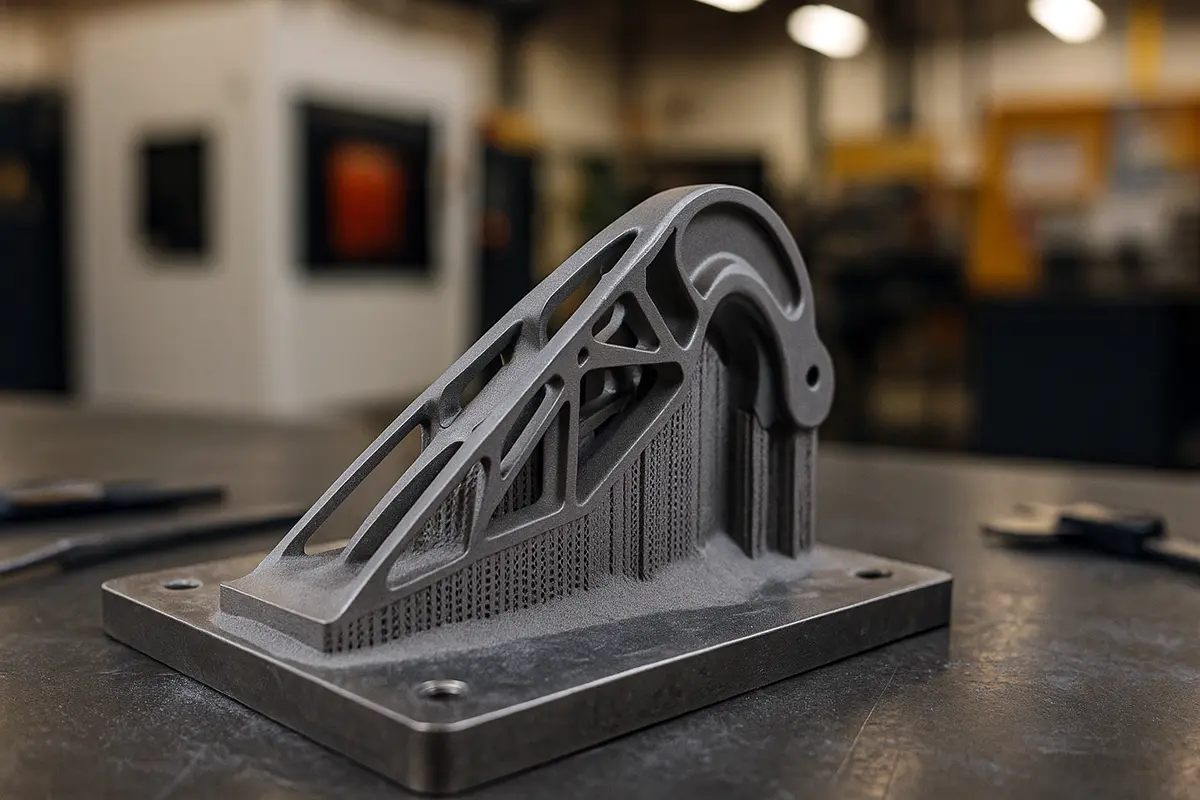
DMLS enables geometry that supports both structural efficiency and functional integration.
Understanding DMLS Constraints and Opportunities
Direct Metal Laser Sintering builds parts layer by layer by selectively melting metal powder. The process supports complex internal channels, feature consolidation, and low-volume production without hard tooling. At the same time, thermal cycling, support requirements, and post-processing dependencies create constraints that must be designed in from the beginning.
Critical Design Considerations
| Design Domain | Primary Risk | Practical Design Response |
|---|---|---|
| Part orientation | Surface quality loss and anisotropic behavior on critical features. | Orient key datums and mating surfaces for best achievable finish and consistency. |
| Support strategy | Warping, thermal distortion, and difficult support removal. | Minimize unsupported overhangs and design access for removal tools. |
| Feature resolution | Thin walls, holes, and channels failing printability limits. | Validate minimum wall and diameter limits by material and machine profile. |
| Thermal management | Residual stress and dimensional drift after build and release. | Use fillets, gradual section changes, and simulation-led compensation. |
Build Orientation and Support Design
Orientation decisions govern more than support volume. They also affect heat flow, local mechanical behavior, and final machining effort. In most production workflows, the best orientation is the one that protects functional interfaces and reduces downstream rework rather than the one with the least raw support material.
- Place critical surfaces where support scarring and distortion risk are minimized.
- Preserve access to support attachment regions for removal tooling.
- Include machining stock on features requiring tighter tolerance than as-built capability.
Advanced Design Techniques for DMLS
Topology Optimization
Topology optimization removes low-value material based on load cases and boundary conditions. For aerospace and automotiveprograms, this can significantly reduce mass while preserving required stiffness and strength envelopes.
| Software Tier | Common Tools | Best Use Pattern |
|---|---|---|
| Enterprise simulation suites | Altair OptiStruct, ANSYS, SIMULIA Tosca, Siemens NX. | Large programs requiring integrated validation workflows. |
| Mainstream CAD-integrated tools | Fusion 360, SolidWorks Simulation, Creo. | Faster iteration inside existing product development pipelines. |
| Specialized geometry platforms | nTop, Grasshopper with engineering plugins. | Complex parametric lattices and advanced feature logic. |
Lattice Structure Integration
Lattices allow precise tuning of stiffness, energy absorption, and weight. They are most effective when treated as engineered internal architecture, not decorative infill.
Lattice Design Sequence
- Define performance targets: stiffness, mass, fatigue behavior, thermal response.
- Select geometry type based on load path and manufacturability.
- Tune cell size, strut thickness, and density using process limits.
- Validate via simulation before committing to physical builds.
| Lattice Type | Typical Strength Behavior | Implementation Note |
|---|---|---|
| Cubic | Balanced, predictable stiffness response. | Straightforward to model and manufacture at scale. |
| Diamond | Strong strength-to-weight and energy absorption. | Useful where impact behavior matters. |
| Gyroid | Smooth stress distribution and good fatigue behavior. | Performs well in continuous load paths. |
| Honeycomb | Efficient in directional loading scenarios. | Effective where in-plane behavior dominates. |
Generative Design and Simulation Integration
Generative design expands the candidate solution space rapidly, but output quality depends entirely on input quality. Load cases, constraints, and manufacturing rules must be precise. Strong teams pair generative outputs with structural, thermal, and distortion simulation before release.
Simulation Categories to Include
- Structural analysis for static and dynamic loading scenarios.
- Thermal and residual stress modeling across build cycles.
- Distortion prediction to pre-compensate critical geometry.
- Flow analysis for internal channels, exchangers, and pressure loss control.
Designing with Post-Processing in Mind
DMLS design quality is ultimately measured after post-processing and inspection, not at build completion. Support removal, heat treatment, machining, and finishing should be treated as core design inputs.
Post-Processing Integration Checklist
- Plan tooling access for support removal before finalizing orientation.
- Include datum and clamping features for secondary machining operations.
- Allocate machining stock on critical dimensions and sealing surfaces.
- Embed inspection references for metrology and process validation.
Industry Application Patterns
| Sector | Design Technique Emphasis | Typical Result |
|---|---|---|
| Aerospace | Topology optimization plus internal cooling architecture. | Lower mass with retained thermal and structural performance. |
| Medical devices | Lattice-enabled porous structures and patient-specific geometry. | Improved fit, biological response, and reduced part mass. |
| Automotive | Generative design for brackets, tooling, and specialty components. | Shorter iteration cycles and reduced development cost risk. |
Conclusion
Advanced DMLS design is not about complexity for its own sake. It is about aligning geometry, material, simulation, and post-processing to achieve a part that performs, inspects, and scales in production. Teams that apply this integrated approach consistently unlock more value from metal additive manufacturing.
Further Reading
- DMLS technology overview
- CNC vs 3D Printing process selection
- How additive evolved from hype to industrial infrastructure
Need DMLS Design Support for a Production Program?
Share your CAD, load requirements, and material constraints. Our team can define an optimization and manufacturing plan that is practical for both performance and production readiness.
Request a manufacturing quote