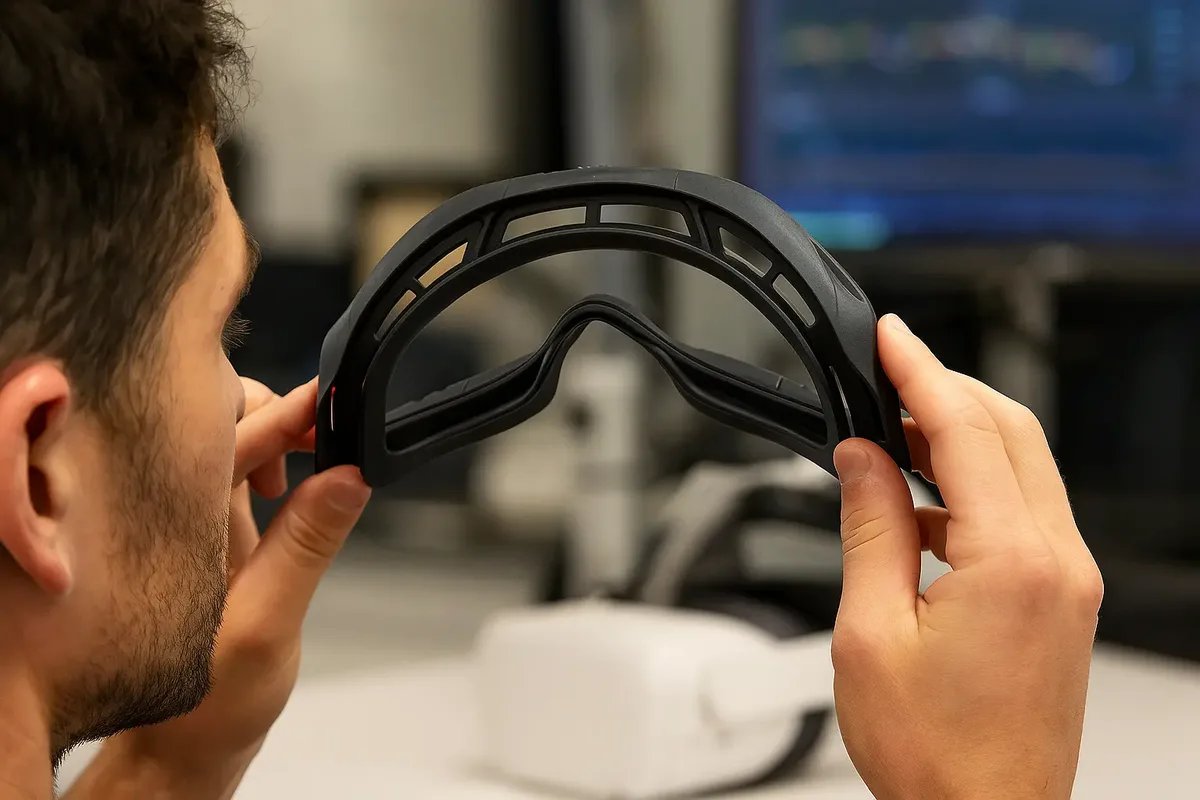
Modern VR headsets are complex assemblies combining precision optics, sensor arrays, embedded electronics, and ergonomic components that must work together seamlessly. While the lenses and displays attract the most attention, some of the most critical components are hidden from view entirely. These are the structural and comfort elements that determine whether a headset can be worn for minutes or hours at a time.
One such component is the visor frame—the facial interface structure that sits between the user's face and the optical assembly. This part must align optics precisely, distribute pressure evenly across the face, block external light, and support modular accessories. It is one of the most ergonomically sensitive components in any headset, and getting it right requires extensive iteration that traditional manufacturing simply cannot support at speed.
Recently, Forge Labs supported the development of a visor component for a next-generation VR headset from a leading hardware platform developer. The project demanded both rapid design iteration during development and production-scale manufacturing for initial hardware runs—a combination where HP Multi Jet Fusion (MJF) and Nylon PA12 proved to be the ideal solution.
Why VR Hardware Benefits from Additive Manufacturing
VR hardware presents a unique set of design challenges that push the limits of conventional manufacturing. Headsets must accommodate the enormous variation in human facial geometry while maintaining optical precision across every unit. The components that interface with the user's face need to be lightweight, structurally sound, and comfortable against skin for extended sessions.
Traditional injection molding has long been the default for consumer electronics at scale. However, it comes with significant constraints during development:
- Tooling costs: A single injection mold for a complex visor geometry can cost $50,000–$150,000 and take 8–12 weeks to produce
- Design lock-in: Once tooling is cut, geometry changes require costly mold modifications or entirely new tools
- Iteration speed: Each design revision adds weeks to the development timeline
- Complexity constraints: Internal features like lattice structures, lightweighting channels, and integrated mounting points require multi-part tooling or secondary assembly
Additive manufacturing eliminates these constraints. Engineers can design organic shapes optimized for comfort, incorporate complex internal features, and produce new revisions overnight. For wearable hardware where ergonomics are paramount, this freedom to iterate is transformative.
Why Additive Manufacturing Excels for VR Components
- Complex organic geometries without tooling
- Rapid ergonomic iteration in days, not months
- Lightweight lattice and thin-wall structures
- Internal mounting features produced in a single build
- No tooling investment or design freeze required
- Test multiple design variants simultaneously
- Scale from single prototypes to production volumes
- Material properties suited for skin-contact wearables
The Project: Custom VR Visor Frames
The project originated from a leading VR hardware developer preparing a new-generation headset platform. The component in question was a custom visor frame—a structural element that serves as the interface between the user's face and the headset's optical assembly. During headset development and into early production runs, the visor needed to meet several demanding requirements:
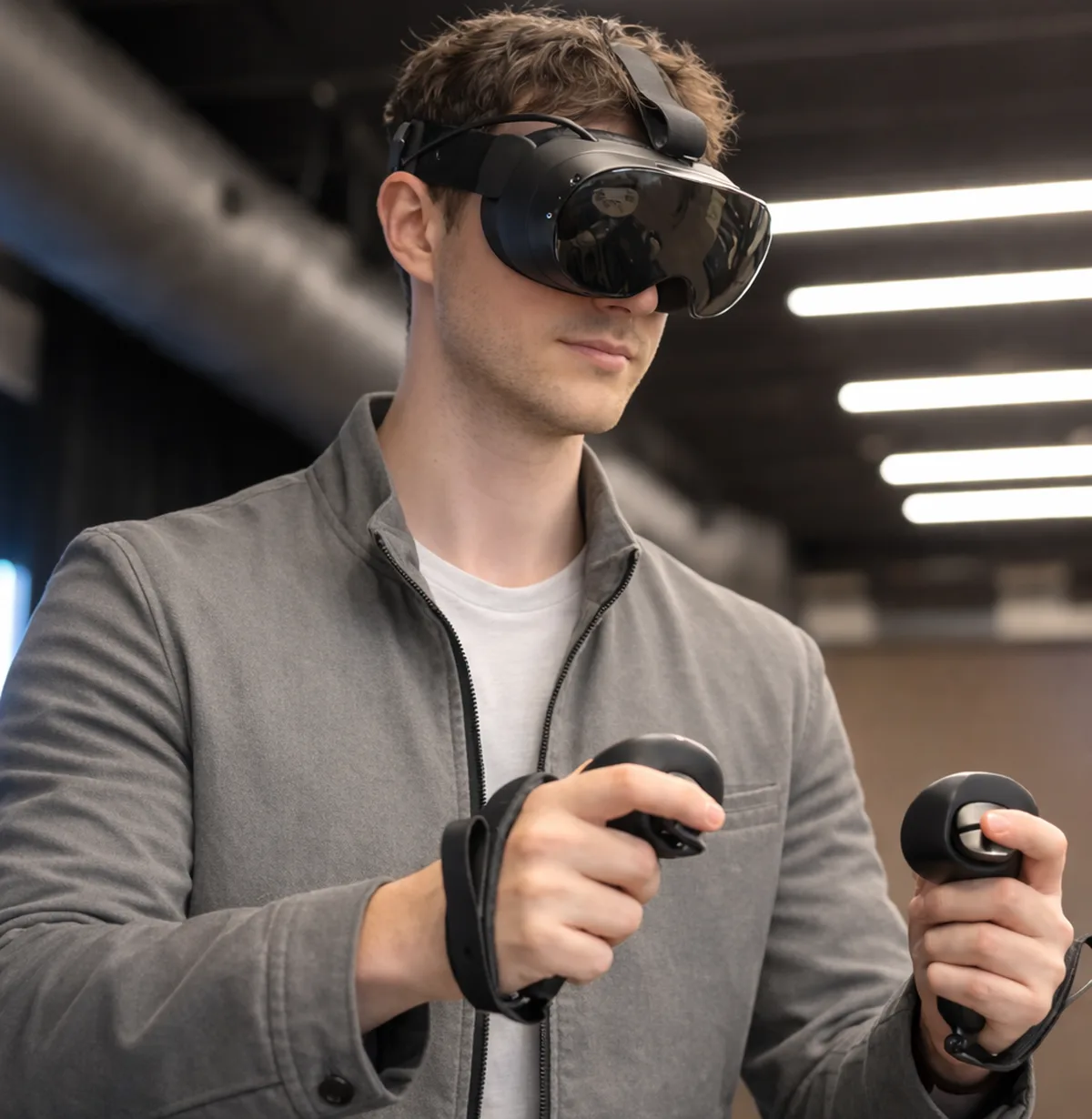
A next-generation VR headset in use, featuring a custom visor frame manufactured in MJF Nylon PA12
- Lightweight rigidity: The visor had to be structurally stiff to maintain optical alignment while adding minimal weight to the headset assembly
- Ergonomic facial interface geometry: The face-contact surfaces needed to distribute pressure evenly and accommodate a wide range of face shapes
- Precise mounting features: Snap fits, alignment pins, and accessory mounting points had to hold tight tolerances for reliable assembly
- Skin-safe material: The visor contacts the user's face for extended periods, requiring a material that is resistant to oils, sweat, and skin irritation
- Production-ready quantities: The project needed to move from design prototypes to hundreds, then thousands of units without switching manufacturing processes
3D printing was chosen not as a stopgap before injection molding, but as the production method itself. The combination of design flexibility during development and throughput capability during production made MJF the clear choice.
Manufacturing ProcessWhy Multi Jet Fusion Was Selected
HP Multi Jet Fusion is a powder bed fusion technology that uses an infrared fusing agent to selectively melt nylon powder layer by layer. Unlike laser-based systems that trace each cross-section with a single point, MJF applies fusing agent across the entire build area and fuses full layers simultaneously. This architecture gives MJF a distinct throughput advantage for production parts.
For this project, MJF offered several critical advantages:
Technology Advantages
- Full-layer fusing for consistent mechanical properties
- High build density—dozens of visors per build
- Excellent dimensional accuracy (±0.3%, min ±0.5 mm)
- No support structures required
- Isotropic strength in XY and Z directions
Production Advantages
- Continuous manufacturing pipeline
- No tooling investment required
- Design changes between builds at zero cost
- Consistent part quality across builds
- Scalable from prototypes to thousands of units
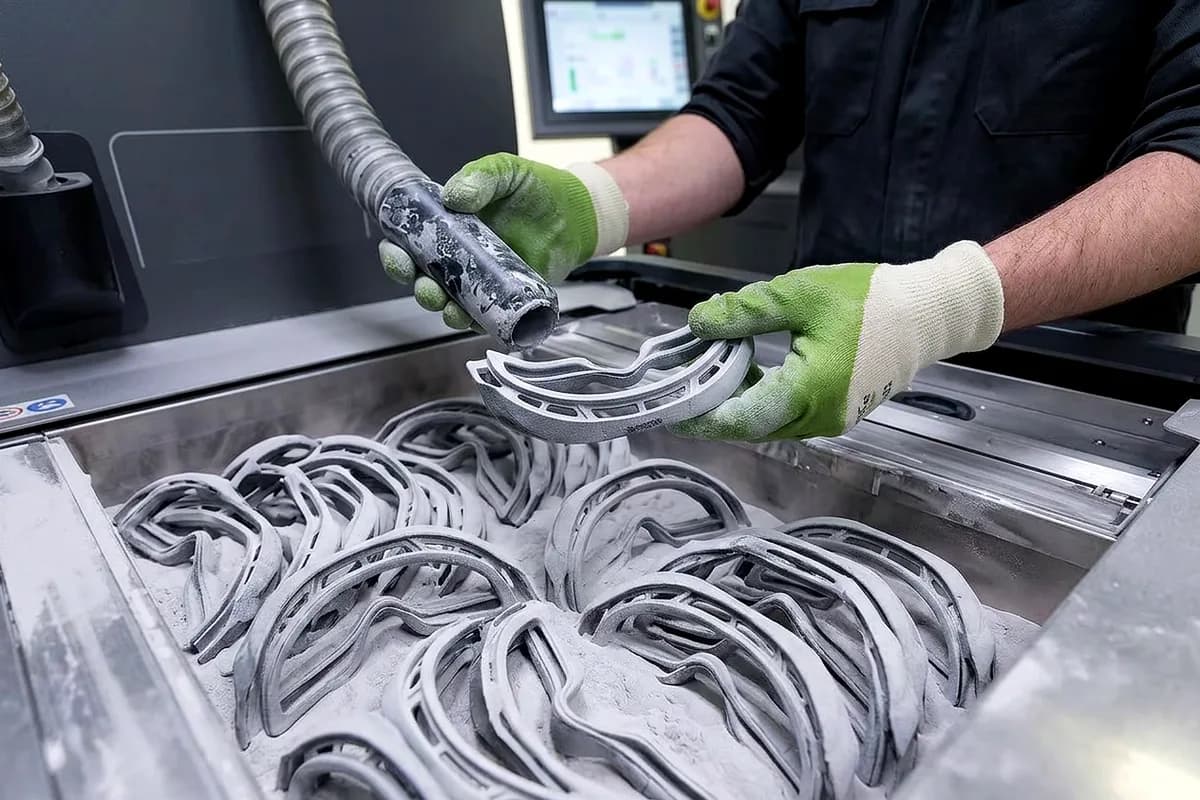
Visor components being depowdered after an MJF build cycle, with unfused PA12 powder brushed away to reveal finished parts
Why Nylon PA12
Nylon PA12 was the clear material choice for a wearable consumer electronics component. It combines the mechanical performance needed for structural applications with the surface and chemical properties required for prolonged skin contact.
| Property | MJF PA12 Value | Why It Matters for VR |
|---|---|---|
| Tensile Strength | 48 MPa | Maintains structural rigidity under strap tension |
| Density | 1.01 g/cm³ | Lightweight for extended wear comfort |
| Elongation at Break | 20% | Resilient snap fits and mounting features |
| Chemical Resistance | Excellent | Resistant to skin oils, sweat, and cleaning agents |
| Surface Finish | Ra 6–10 μm (as-printed) | Comfortable matte texture against skin |
PA12 also offers excellent long-term stability. Unlike some engineering plastics, it resists moisture absorption and maintains its dimensions over time—important for a precision component that must maintain optical alignment across the product's lifespan.
Rapid Iteration During Development
The development phase of any VR headset involves extensive ergonomic testing. Engineers need to evaluate how the headset feels across a wide range of face shapes, head sizes, and use scenarios. The visor geometry directly affects pressure distribution, light leakage, field of view, and thermal comfort—all factors that are nearly impossible to predict through simulation alone.
SLS for Initial Fit Testing
For the earliest design iterations, many of the initial visor builds were produced on our EOS P 110 Selective Laser Sintering (SLS) system rather than MJF. This was a deliberate choice driven by the realities of rapid iteration at low volumes.
SLS offered several advantages during the initial fit-testing phase. The EOS P 110's smaller build chamber meant significantly shorter build and cooling cycles compared to the larger MJF HP 5200 platform. Where an MJF build requires a full build-cool-unpack cycle that can span 24+ hours regardless of how few parts are in the chamber, the P 110 could complete a small batch of visor prototypes and cool to handling temperature in a fraction of that time. For a team that needed two or three visor variants by the next morning, this speed difference was critical.
SLS PA12 also delivered tighter dimensional accuracy during these initial builds. As detailed in our MJF vs SLS comparison, SLS PA12 (PA2200) achieves comparable tolerance specs to MJF but with more flexible layer height options (60–100 microns vs. MJF's fixed 70 microns) and superior build volume uniformity in the center of the bed. For visor frames where mounting features needed to mate precisely with optical assemblies on the first attempt, this accuracy advantage reduced the number of iterations needed to nail the fit.
Why SLS First, Then MJF
- Faster cycle times: The EOS P 110's smaller build chamber and shorter cooling cycles enabled same-day or next-day turnaround for small batches
- Higher accuracy for fit testing: SLS PA12 provided tighter tolerances on critical mounting features, reducing iteration cycles
- Lower volume flexibility: No need to fill a large build chamber when only 3–5 variants were needed
- Same material family: Both SLS and MJF use PA12, so fit-test results translated directly to production geometry
Once the visor geometry was validated through SLS prototyping and the design stabilized, production transitioned to MJF on the HP 5200 for its superior throughput at volume. The combination of SLS for rapid initial iteration and MJF for production scale gave the project the best of both technologies.
Production Iteration on MJF
As the design matured and iteration volumes increased, the workflow shifted to MJF for its production-scale throughput:
Development Iteration Timeline
- Day 1: Engineers submit revised visor geometry based on ergonomic testing feedback
- Day 1–2: New visor variants are nested into the next available MJF build
- Day 2–3: Parts are depowdered, cleaned, and shipped to the development team
- Day 3–4: New variants are tested on hardware prototypes and user study participants
Complete design-to-test cycles in under 72 hours, compared to 8–12 weeks for injection mold modifications.
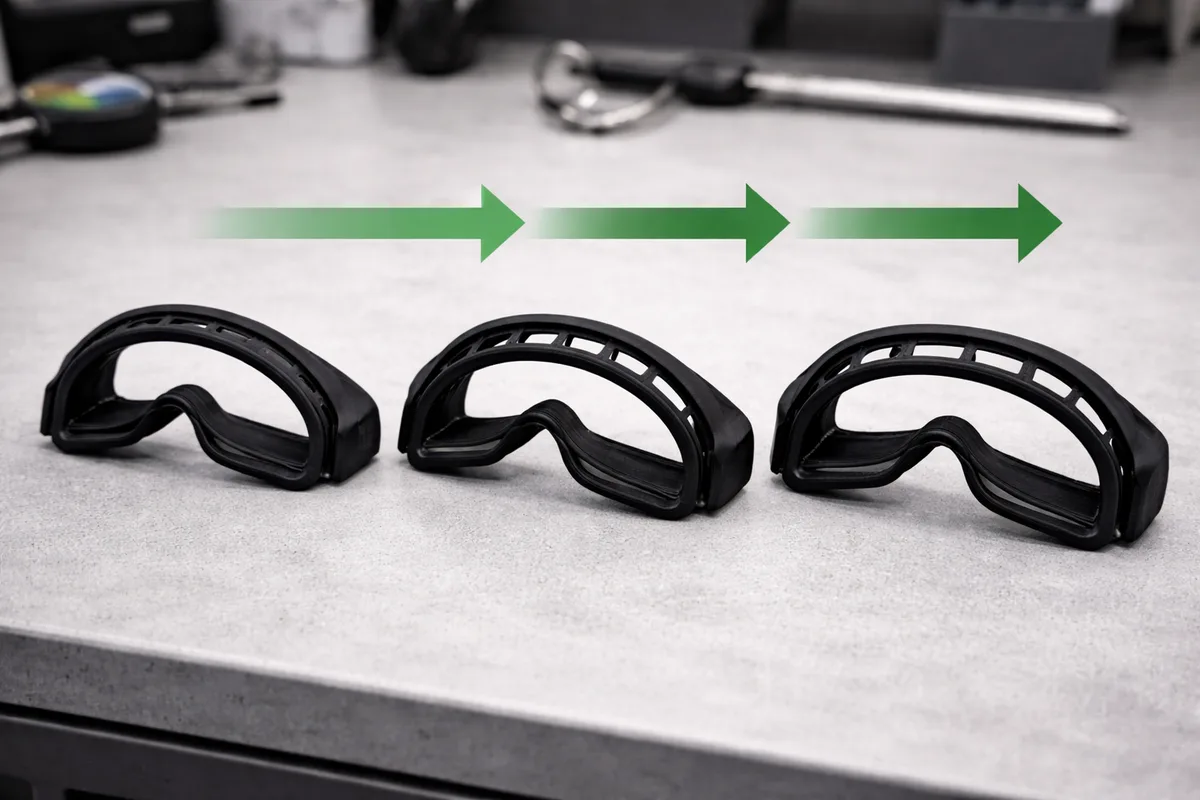
Progressive design iterations of the visor frame, with each revision refining ergonomics based on user testing feedback
This speed allowed the development team to test multiple ergonomic variants simultaneously. Instead of committing to a single geometry and hoping it worked, engineers could produce three or four different visor profiles in a single build, distribute them to testers, and converge on the optimal design through real-world data.
Critical design parameters that were refined through rapid iteration included:
- Facial contact surface curvature: Adjusted to distribute pressure evenly across the brow, cheeks, and nose bridge
- Nose bridge clearance: Modified to accommodate a wider range of nose geometries
- Structural reinforcement ribs: Optimized for weight reduction without sacrificing stiffness
- Mounting point geometry: Refined for reliable snap-fit assembly and disassembly
- Ventilation channels: Tuned to balance airflow with light leakage control
Each of these refinements would have required a mold modification in traditional manufacturing. With MJF, they were incorporated into the next print file at zero additional cost.
Scaling to Production Volumes
As the design matured and the headset moved toward production, the project transitioned from iterative prototyping to sustained manufacturing runs. This is where the throughput of MJF on Forge Labs' HP 5200 production systems became the decisive factor.
Production Output
Over 1,000 visor components every 72 hours
Using Forge Labs' HP 5200 systems running continuous production cycles, initial hardware runs were fulfilled entirely through additive manufacturing—no injection molds, no tooling lead times, no minimum order quantities.
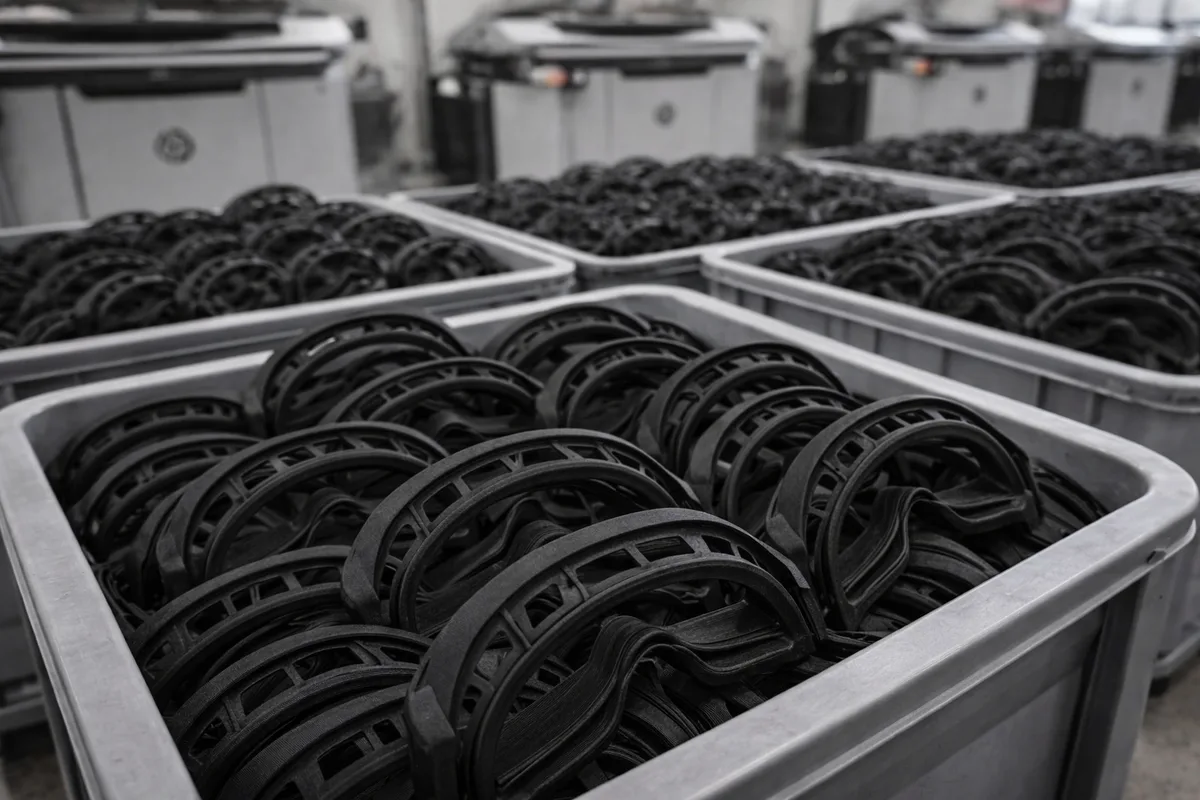
Bins of finished visor components from a production run, demonstrating the throughput achievable with HP Multi Jet Fusion
The HP 5200 platform is specifically designed for production throughput. Its build volume (380 × 284 × 380 mm) allows high packing density for components like visor frames, and its continuous build-cool-unpack workflow enables back-to-back manufacturing cycles without downtime.
Why MJF Excels at Production Scale
- High Density: Visor frames nest efficiently in the build volume, maximizing output per cycle.
- No Supports: Unfused powder supports parts during the build, enabling 3D nesting throughout the full volume.
- Consistent Quality: Part-to-part and build-to-build consistency meets production quality requirements.
For the client, this meant they could begin shipping hardware without waiting for injection mold tooling. Early production units used 3D printed visors directly, with the option to transition to molding only if volumes justified the tooling investment—a decision they could make with real market data rather than forecasts.
Surface Finishing: Vapor Smoothing
During the project, the team evaluated vapor smoothing as a surface finishing option for the visor components. Vapor smoothing is a chemical post-processing technique that exposes MJF parts to a controlled solvent vapor, which partially melts the outer surface to produce a smooth, sealed finish.
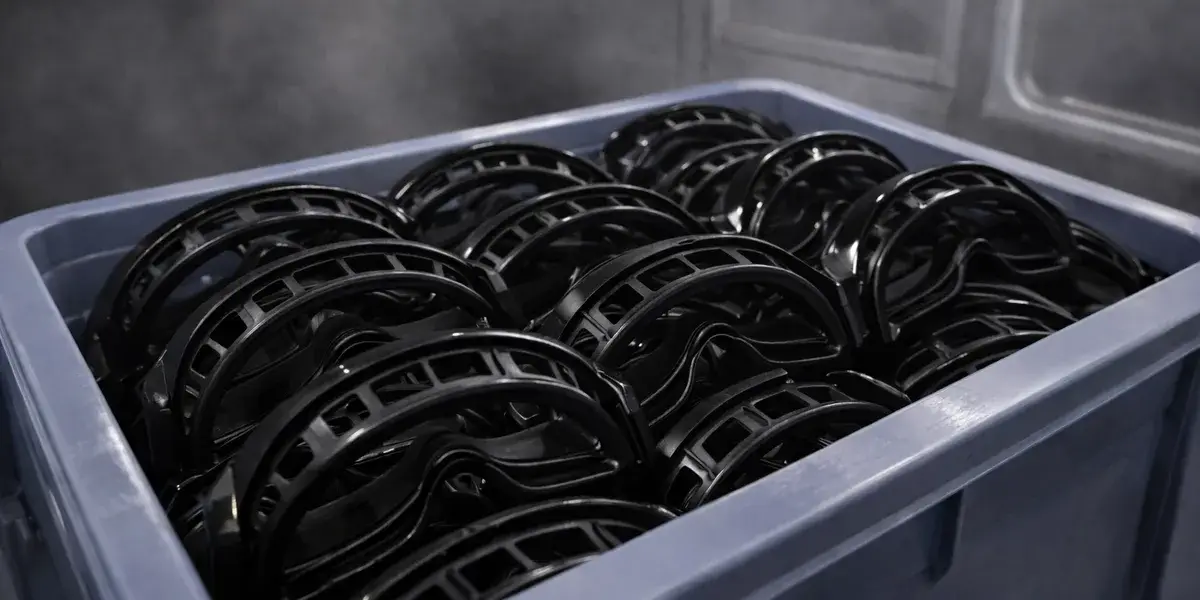
A batch of visor components after vapor smoothing, showing the glossy, sealed surface finish that gives parts an injection-molded appearance
Benefits of Vapor Smoothing
- Smooth, sealed surface texture
- Premium tactile feel against skin
- Improved abrasion resistance
- Reduced surface porosity
- Enhanced aesthetic finish
Tradeoffs Considered
- Additional processing time per batch
- Added cost per component
- Slight dimensional changes to account for
- Additional supply chain step
For early development builds, some visor components were vapor smoothed to evaluate the cosmetic and tactile improvements. The results were impressive—the smoothed parts had a sophisticated, injection-molded feel that would be indistinguishable from traditionally manufactured components in a consumer product.
However, the final production decision came down to a practical assessment: the visor frame sits inside the headset assembly and is largely hidden from view during normal use. The face-contact areas are covered by a foam gasket, and the structural elements are concealed within the headset shell. Given that the as-printed MJF surface was already comfortable and functional, the team ultimately decided to skip vapor smoothing for most production units, prioritizing speed and cost efficiency. Select units for display hardware and review samples continued to receive the smoothed finish.
Industry ContextVR Companies Using 3D Printed Components
This project is part of a broader industry trend. VR hardware manufacturers are increasingly turning to additive manufacturing not just for prototyping, but as a production technology for components that benefit from geometric complexity and customization.
Bigscreen Beyond: Mass Customization in VR
One of the most prominent public examples is Bigscreen Beyond, a compact VR headset that uses 3D printed face interfaces customized to each individual user. Customers submit a 3D face scan captured with their smartphone, and Bigscreen manufactures a unique facial interface geometry for every unit sold. This approach delivers:
- Ultra-lightweight headset design (127g total weight)
- Personalized comfort with custom face-contact geometry
- Superior light blocking due to precise facial contour matching
- No need for adjustable facial interface mechanisms, reducing weight and complexity
Bigscreen's approach demonstrates that 3D printing in VR hardware is not a compromise—it enables product features that are simply impossible with traditional manufacturing.
Broader VR Industry Applications
Beyond custom face interfaces, VR and AR companies use additive manufacturing for a range of components:
- Optical alignment structures: Precision mounting for lenses and waveguides
- Sensor housings: Custom enclosures for tracking cameras and IMUs
- Ventilation components: Complex airflow channels for thermal management
- Development housings: Rapid enclosure iterations during hardware R&D
- Accessory mounting systems: Modular attachment points for straps, audio, and accessories
Why 3D Printing Is Ideal for Wearable Hardware
The advantages demonstrated in this VR visor project apply broadly to any wearable hardware category. Whether the product is a VR headset, AR glasses, a medical device, or a consumer wearable, the same manufacturing challenges appear: ergonomics matter deeply, development cycles are aggressive, and early production volumes rarely justify injection mold tooling.
| Factor | Injection Molding | MJF Production |
|---|---|---|
| First Part Lead Time | 8–12 weeks (tooling) | 2–3 days |
| Design Change Cost | $5,000–$50,000+ per revision | $0 (update file and print) |
| Minimum Order Quantity | Thousands (to amortize tooling) | 1 unit |
| Geometric Complexity | Limited by mold draft and undercuts | Virtually unconstrained |
| Production at 1,000 units | Economical only after tooling ROI | 72-hour turnaround |
For hardware startups and established companies alike, MJF production fills a critical gap: the volume range between “we need a few prototypes” and “we're ready for 100,000-unit injection mold runs.” Many products live in this gap for months or years, and additive manufacturing lets them ship real products to real customers during that period.
Lessons from the Project
This VR visor project reinforced several principles that apply to any hardware team considering additive manufacturing for production:
Key Takeaways
- Design for the process, not around it. The visor geometry was designed from the start to leverage MJF's strengths—lattice structures, thin walls, and integrated mounting features that would be impossible or impractical with injection molding.
- Staying in one material family removes the transition gap. Fit-test builds ran on SLS for faster turnaround, then production moved to MJF for throughput and a slightly better finish. Because both use PA12, there was no “will it work at scale” uncertainty when the design moved to production.
- Surface finishing should be a deliberate engineering decision. Vapor smoothing added real value for cosmetic applications, but for hidden components, the as-printed finish was more than adequate. Matching the finish to the functional requirement saved time and cost.
- Throughput matters as much as capability. Many additive technologies can produce excellent parts, but not all can sustain production volumes. The HP 5200's throughput—over 1,000 visors every 72 hours—was essential to meeting the production schedule.
- Additive manufacturing delays the tooling decision, not the product launch. By producing initial units through MJF, the hardware team shipped product on schedule while preserving the option to transition to injection molding when volumes and design stability justified the investment.
Conclusion
VR hardware is evolving rapidly, and the components that define user experience are becoming more complex, more ergonomic, and more personalized. The visor frame may be hidden inside the headset, but it plays a critical role in determining whether a headset is comfortable enough for hours of immersive use.
For this project, HP Multi Jet Fusion and Nylon PA12 met the project’s needs: the speed to iterate daily during development, the throughput to produce over 1,000 components every 72 hours during production, and the material performance to meet the demands of a consumer wearable product.
As VR, AR, and wearable hardware continue to evolve, additive manufacturing is becoming an essential production technology—not just a prototyping tool. For engineering teams building the next generation of immersive devices, the question is no longer whether to use 3D printing, but how to design for it from the start.
Building VR, AR, or Wearable Hardware?
Forge Labs specializes in production-scale MJF manufacturing for consumer electronics and wearable hardware. From rapid prototyping through production runs, our HP 5200 systems and engineering team support hardware development from concept to market.
Get a production quote